


Analysis
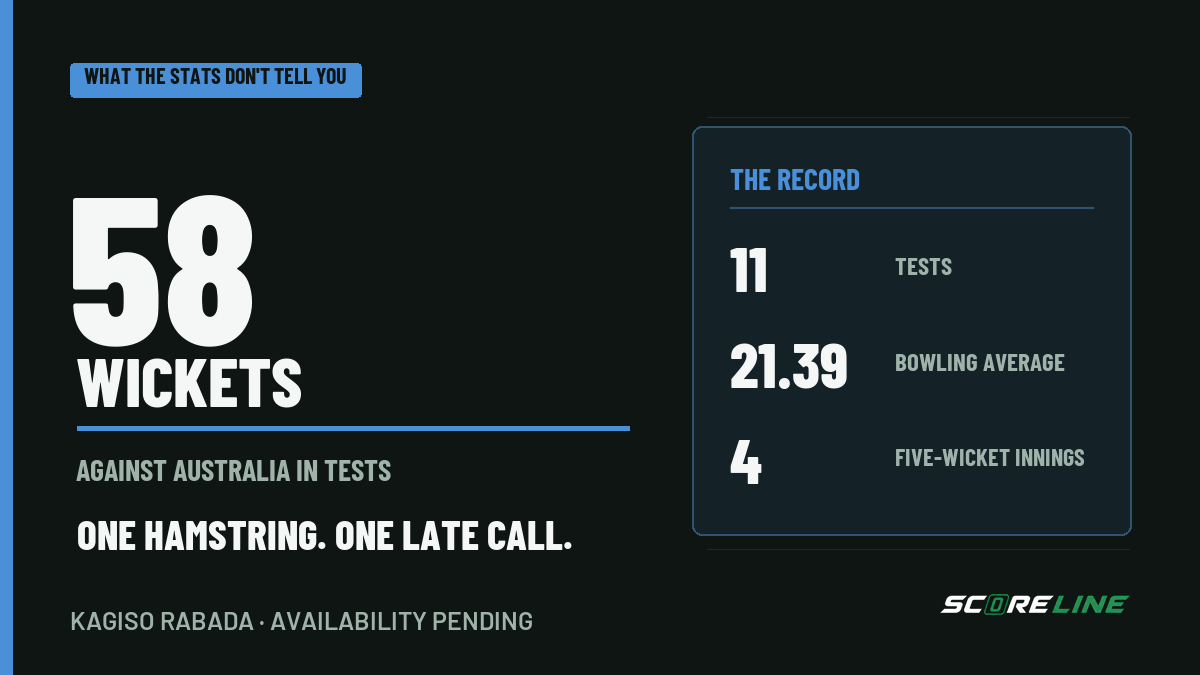
Some numbers you read. Others you feel in your chest. Fifty-eight Australian wickets in 11 Tests is the second kind, and two days before the series starts nobody can say for sure whether the man who took them will bowl a ball. Look up the Rabada Test record. Australia have spent ten years wishing it were shorter.
Kagiso Rabada is nursing a right hamstring injury, and the Proteas will decide on him “as late as possible”, batting coach Ashwell Prince said on Tuesday 6 October, as reported by TimesLIVE. Lungi Ngidi is already ruled out of the first Test with a hamstring problem of his own. The first Test starts on Friday at Hollywoodbets Kingsmead Stadium in Durban. These are South Africa’s first home Tests since they won the World Test Championship at Lord’s in 2025, and the series counts towards the 2025-27 cycle. That is the stake. Now the numbers, and the gaps in them.
| Quick facts | |
|---|---|
| Match | South Africa v Australia, first Test of three |
| Dates | Friday 9 to Tuesday 13 October 2026 |
| Venue | Kingsmead, Durban |
| Daily start | 09:30 SAST (Cricket South Africa) |
| Rest of the series | Gqeberha from 18 October, Cape Town from 27 October |
| Competition | ICC World Test Championship 2025-27 |
| Rabada v Australia (Tests) | 11 Tests, 58 wickets, average 21.39 |
| Team news | Rabada (right hamstring) a late call; Ngidi (hamstring) out |
The Rabada Test record: Australia in numbers
Every figure here is from ESPNcricinfo’s Statsguru, Tests only, checked this morning.
Against Australia, Rabada has 58 wickets in 11 Tests at an average of 21.39. He has bowled 360.1 overs, 72 of them maidens, at an economy rate of 3.44 runs an over. His strike rate is 37.2, the number of balls per wicket. He has four five-wicket innings, one ten-wicket match, a best innings of 6/54 and best match figures of 11/150.
| Test | Rabada’s match figures | Result for South Africa |
|---|---|---|
| Perth, November 2016 | 7/170 | Won by 177 runs |
| Hobart, November 2016 | 5/54 | Won by an innings and 80 runs |
| Adelaide, November 2016 | 3/112 | Lost by 7 wickets |
| Durban, March 2018 | 4/102 | Lost by 118 runs |
| Gqeberha, March 2018 | 11/150 | Won by 6 wickets |
| Cape Town, March 2018 | 5/122 | Won by 322 runs |
| Johannesburg, March 2018 | 3/69 | Won by 492 runs |
| Brisbane, December 2022 | 8/89 | Lost by 6 wickets |
| Melbourne, December 2022 | 2/144 | Lost by an innings and 182 runs |
| Sydney, January 2023 | 1/119 | Drawn |
| Lord’s, June 2025 (WTC final) | 9/110 | Won by 5 wickets |
What the numbers seem to say
Read straight, the record says Australia have never solved him, least of all in South Africa. In four home Tests against them, all in 2018, he took 23 wickets at 19.26 and went at 3.14 an over, with 40 maidens in 140.5 overs. In six Tests in Australia he took 26 wickets at 26.46, conceding 3.70 an over. Then came the one neutral Test, the final at Lord’s, where he took 9/110.
The easy conclusion: a fast bowler Australia have rarely mastered, at his sharpest on South African pitches. True, as far as it goes. It does not go far enough.
What actually happened
In 2016 a young Rabada took 7/170 in Perth and 5/54 in Hobart, and South Africa won both Tests before losing in Adelaide. In 2018, at home, the series began with a 118-run defeat in Durban, where he took 4/102. Then came Gqeberha: 5/96 in the first innings and 6/54 in the second, from 22 overs with nine maidens. South Africa won that Test by six wickets, and the next two by 322 and 492 runs.
The 2022/23 tour is where the line dips. His three Tests that season brought 11 wickets at 32.00, at 4.54 an over. Eight of those came in Brisbane, including 4/13 in four second-innings overs, and South Africa still lost by six wickets. At Melbourne he took 2/144 from 28 overs in an innings defeat, and at Sydney 1/119, again from 28 overs, in a draw.
And then Lord’s, June 2025: 5/51 and 4/59, a five-wicket win, and a title.
Why the gap exists: what the stats don’t tell you
Wickets and wins do not move together. His best match return on the 2022/23 tour, 8/89 in Brisbane, came in a defeat. His smallest haul of the 2018 series, 3/69 in Johannesburg, came in a 492-run win. A bowling average measures the batters who got out. It says nothing about the runs on the board or the state of the series.
The scorecard has no column for pressure. Those 72 maidens against Australia are the nearest thing the numbers have to a pressure gauge, and even they are blunt. A maiden looks the same in the record whether the new ball was talking or the game was drifting. The nine maidens in his 22 overs at Gqeberha tell you he gave nothing away. They cannot tell you which wickets at the other end that squeeze helped to buy. Nothing in the record can.
The average blends four different bowlers. The 2016 tourist, the 2018 home spearhead, the 2022/23 bowler who went at 4.54 an over, and the Lord’s finalist are all folded into 21.39. The figures show the dip in Melbourne and Sydney clearly. They do not explain it, and we will not pretend to.
And the number knows nothing about this week. Statsguru records what Rabada has done, not what his hamstring will allow on Friday. According to cricket.com.au, he had not played since the IPL in May. Prince was honest about where that leaves him: “It’s fair to say he is obviously not going to be at 100% straight away, but he is looking good.” On the two-day intra-squad game in Durban, which ended on Monday, Prince added: “He came through quite nicely, bowled really well and he will continue to be involved in training in the next few days right up to the match.”
What it means next: the attack without him
This is the uncomfortable part. Cricket South Africa named 18 players on 28 September, and left out Ngidi, Ottneil Baartman and Kwena Maphaka, all three rehabilitating hamstring injuries. TimesLIVE now describes a 17-man squad that stays together for the week. The paper also reports growing optimism that Ngidi will be fit for the second Test in Gqeberha.
Here is what the rest of the bowling group brings to Kingsmead, in Tests:
| Bowler | Tests | Wickets | Average | Against Australia |
|---|---|---|---|---|
| Marco Jansen | 21 | 89 | 21.12 | 4 Tests, 8 wickets at 38.37 |
| Anrich Nortje | 19 | 70 | 26.71 | 3 Tests, 7 wickets at 31.00 |
| Wiaan Mulder | 24 | 38 | 26.00 | 1 Test, 1 wicket |
| Dane Paterson | 7 | 25 | 26.24 | No Test against Australia |
| Corbin Bosch | 4 | 16 | 18.87 | No Test against Australia |
| Gerald Coetzee | 4 | 14 | 23.57 | No Test against Australia |
| Keshav Maharaj (spin) | 62 | 218 | 29.22 | 10 Tests, 23 wickets at 44.78 |
| Lungi Ngidi (out of the first Test) | 20 | 58 | 23.37 | 4 Tests, 10 wickets at 29.10 |
Among the seamers in the squad, Rabada has 58 Test wickets against Australia. The next best is Jansen, with eight. That is the real gap, and it is bigger than any average.
There is talent in that table. Jansen’s overall Test average of 21.12 sits just below Rabada’s against Australia. Nortje is recalled after last playing a Test in 2023, as Fluit’s Five covered on Tuesday. Bosch and Paterson already have Test five-wicket hauls in short careers. Keshav Maharaj brings 218 Test wickets, though his average against Australia is 44.78.
What none of them has is Rabada’s history against these opponents. Three of the seamers, Paterson, Bosch and Coetzee, have never played a Test against Australia.
That is the choice facing Temba Bavuma and the selectors before Friday morning. A Rabada who, in his batting coach’s words, will not be at 100% straight away, or an attack whose most successful seamer against Australia, Rabada aside, has eight Test wickets against them. The numbers make the case for Rabada. Only the hamstring can sign it off.
Frequently asked questions
Is Kagiso Rabada playing in the first Test against Australia?
That has not been decided. Batting coach Ashwell Prince said on Tuesday 6 October, as reported by TimesLIVE, that the decision on Rabada, who has a right hamstring injury, will be left as late as possible. Prince said he bowled really well in the practice game that finished on Monday, though he will not be at full fitness straight away.
What is Kagiso Rabada’s Test record against Australia?
According to ESPNcricinfo’s Statsguru, Rabada has taken 58 wickets in 11 Tests against Australia at an average of 21.39. His best innings figures are 6/54 and his best match figures 11/150, both in Gqeberha in 2018. He also took 9/110 in the 2025 World Test Championship final at Lord’s.
Why is Lungi Ngidi not playing in the first Test?
Ngidi has a hamstring injury and was not considered for the first Test squad, according to Cricket South Africa. TimesLIVE reports growing optimism that he will be available for the second Test in Gqeberha, which starts on 18 October.
When and where is the first Test between South Africa and Australia?
The first Test runs from Friday 9 to Tuesday 13 October 2026 at Kingsmead in Durban, starting at 09:30 SAST each day. The second Test follows in Gqeberha from 18 October and the third in Cape Town from 27 October. The series counts towards the ICC World Test Championship 2025-27.
Who could lead the Proteas attack if Rabada misses out?
Marco Jansen has the most Test wickets among the other seamers in the squad, 89 at an average of 21.12, including eight against Australia. Anrich Nortje, recalled after last playing a Test in 2023, has seven Test wickets against Australia. Keshav Maharaj leads the spin with 218 Test wickets.