


Every over bowled in Durban this week is watched twice: once from the stands, and once by a league table that will not be settled until next year. Here is the short answer. Each Test against Australia is worth 12 points, South Africa began the series second in the ICC table on 75.00 per cent, and because the Proteas play only 14 Tests in this cycle, a single result moves them further than it moves almost anyone else. That is why the WTC final qualification scenarios for the defending champions can change so sharply in a fortnight, and why a draw is never just a draw.
A note on timing. This was written early on Sunday 11 October, before day three of the first Test at Hollywoodbets Kingsmead Stadium. The match is live, so we do not call it; our day-one report has how it began. What follows is the arithmetic for every possible result, here and at Dafabet St George’s Park in Gqeberha next.
| Quick facts | |
|---|---|
| Competition | ICC World Test Championship 2025-27 |
| Points per Test | Win 12, tie 6, draw 4, defeat 0 |
| Table decided by | Percentage of points won from points contested |
| South Africa before the series | Second, 36 points from four Tests, 75.00% |
| Australia before the series | First, 96 points from ten Tests, 80.00% |
| The series | Durban 9 to 13 October; Gqeberha 18 to 22 October; Cape Town 27 to 31 October |
| The final | The Oval, London, 9 to 13 June 2027 |
How the WTC final qualification scenarios work
The championship folds ordinary bilateral series into one two-year league. Nine teams take part, and each meets six of the other eight, half the series at home and half away, according to the ICC. Four steps decide the finalists.
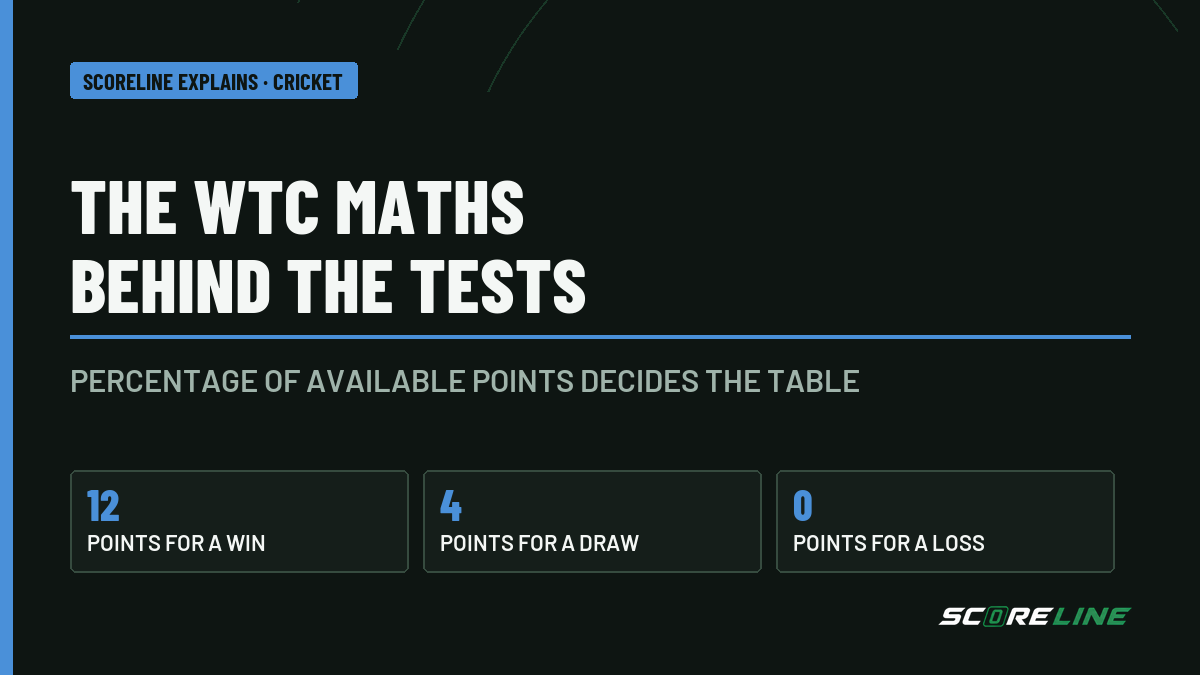
Step one: every Test carries the same prize. Victory brings 12 points, a tie six, a draw four and a defeat none. Series length makes no difference, so this three-Test series puts 36 points on the table.
Step two: points become a percentage. Australia are down for 22 Tests this cycle; South Africa have 14. Raw points would reward whoever plays most, so the ICC ranks sides on the share of available points they have won. Its championship FAQ says this keeps teams comparable at any stage and stops a cancelled series bending the table.
Step three: slow over rates cost points. Article 16.11.2 of the playing conditions takes away a point for each over a team falls behind, once time allowances are counted. Pakistan were docked 11 points that way at Edgbaston in September.
Step four: the top two meet once. When the league ends, the two highest percentages contest a one-off final, at The Oval, 9 to 13 June 2027.
For the full rulebook and the competition’s short history, read how the World Test Championship works.
Where the Proteas stood when Australia arrived
South Africa arrived in Durban as champions: Temba Bavuma and his side chased 282 at Lord’s in June 2025 and won that final by five wickets, against these same opponents. Their start to this cycle was short and sharp. They drew 1-1 in Pakistan, then won both Tests in India in November 2025, which the ICC said lifted them to second. Three wins and one defeat from four Tests is 36 points out of a possible 48, which is 75.00 per cent.
Australia were top with eight wins from ten Tests. One of their two defeats was Bangladesh’s first Test win on Australian soil, in Darwin, before Australia levelled that series. This is the table the ICC published in its state of play update on 7 October 2026:
| Team | Tests | Won | Percentage |
|---|---|---|---|
| Australia | 10 | 8 | 80.00 |
| South Africa | 4 | 3 | 75.00 |
| New Zealand | 6 | 4 | 72.22 |
| Bangladesh | 6 | 3 | 55.56 |
| India | 11 | 5 | 51.52 |
| England | 16 | 7 | 38.54 |
| Sri Lanka | 6 | 1 | 33.33 |
| West Indies | 12 | 2 | 20.83 |
| Pakistan | 9 | 2 | 4.63 |
Read the second line carefully. South Africa’s 75.00 rests on four Tests, so it is far more fragile than Australia’s 80.00, which rests on ten.
What Kingsmead can change
Think of the percentage as a running average. After Durban, South Africa will have contested 60 points across five Tests and Australia 132 across eleven. Using the ICC’s 7 October figures, and assuming no over-rate penalties and no other championship results in the meantime, this is where each outcome leaves the two sides:
| Kingsmead result for South Africa | SA points | SA % | Australia % |
|---|---|---|---|
| Win | 48 of 60 | 80.00 | 72.73 |
| Draw | 40 of 60 | 66.67 | 75.76 |
| Defeat | 36 of 60 | 60.00 | 81.82 |
Three things stand out. A home win would carry the Proteas past Australia to the top. A draw would cost them more than eight percentage points without losing, and drop them below New Zealand on 72.22. A defeat would open a gap of more than 21 points of percentage between the two finalists from Lord’s.
Why does a draw hurt? Four points out of 12 is 33.33 per cent. Any Test that returns less than your current average drags the average down, and for a team sitting on 75.00, only a win keeps it from falling. That is worth remembering this week, because bad light cut both of the first two days short in Durban, as SA Cricket Mag and TimesLIVE reported, and lost overs make a draw more likely. A tie would be worth six points to each side.
What St George’s Park could add
The second Test runs from 18 to 22 October in Gqeberha, as confirmed in Cricket South Africa’s season fixtures and the ICC’s schedule, and listed again by cricket.com.au on 8 October. Combine the first two Tests, on the same assumptions, and the picture sharpens:
| South Africa’s two results | SA points (of 72) | SA % | Australia % |
|---|---|---|---|
| Two wins | 60 | 83.33 | 66.67 |
| One win, one draw | 52 | 72.22 | 69.44 |
| One win, one defeat | 48 | 66.67 | 75.00 |
| Two draws | 44 | 61.11 | 72.22 |
| One draw, one defeat | 40 | 55.56 | 77.78 |
| Two defeats | 36 | 50.00 | 83.33 |
The extremes tell the story. Two wins would put South Africa clear at the top and push Australia below New Zealand. Two defeats would leave the Proteas on 50.00 per cent, behind Bangladesh and India as the table stood on 7 October. Split the two Tests, one won and one lost, and South Africa would sit on 66.67, below both Australia and New Zealand.
These are snapshots, not predictions: other teams play in the same window, and the ICC keeps the official table. The third Test, in Cape Town at the end of October, then puts the last 12 points of the series up for grabs.
Common misunderstandings
“Winning the series is what counts.” Not in this competition. There are no points for a series result. Every Test is scored on its own, so the points tell the story, not the trophy at the end.
“Total points decide the table.” They do not. Before Durban, Australia had 96 points to South Africa’s 36, yet the gap between them was five percentage points.
“A draw is a safe result.” For a side as high as the Proteas, it is a step backwards. A draw only helps a team whose percentage is below 33.33.
Why it matters this season
Fourteen Tests is a short cycle, with little room to recover from a bad fortnight. After this series the Proteas have seven championship Tests left: Bangladesh at home in November, England at home over December and January, and two in Sri Lanka. On ScoreLine’s arithmetic, ten wins from ten from the start of this series would finish them on 92.86 per cent, and each of those wins turned into a defeat would knock off more than seven points.
Australia still have four Tests against New Zealand and five against India after this tour. So this is the one block of the cycle where South Africa can take points from the leaders head to head: every home win is 12 points gained and 12 denied to the side above them. That is the real weight of the next three weeks.
Who is carrying that load? Meet the players on the Proteas Test team page, and revisit the Durban build-up in our first Test preview. Then keep this page handy. When the last ball is bowled at Kingsmead, the tables above will tell you exactly where the champions stand.
Frequently asked questions
How many WTC points is a Test worth?
Twelve, in every series, whatever its length. Victory takes the full 12, a tie gives each side six, a draw gives each side four and a defeat gives nothing. A slow over rate can also cost a point for each over a team is behind.
Why is the WTC table ranked by percentage and not points?
Because schedules are uneven: Australia play 22 Tests in 2025-27 and South Africa only 14. Measuring each team’s share of the points it has played for, rather than its total, keeps the comparison fair throughout the two years.
Where were South Africa in the WTC table before the Australia series?
Second, according to the ICC’s update of 7 October 2026, with three wins and one defeat from four Tests for 75.00 per cent. Australia were top on 80.00 per cent and New Zealand were third on 72.22 per cent.
What happens to the Proteas if the Kingsmead Test is drawn?
On the ICC’s 7 October figures, with no over-rate penalties and no other results in between, South Africa would drop to 66.67 per cent and Australia would move to 75.76 per cent. New Zealand, on 72.22, would then sit above South Africa as well.
When is the next World Test Championship final?
The ICC has set the 2027 final for The Oval, London, starting on 9 June and running to 13 June. The two teams with the highest percentages when the league stage ends will contest it.