


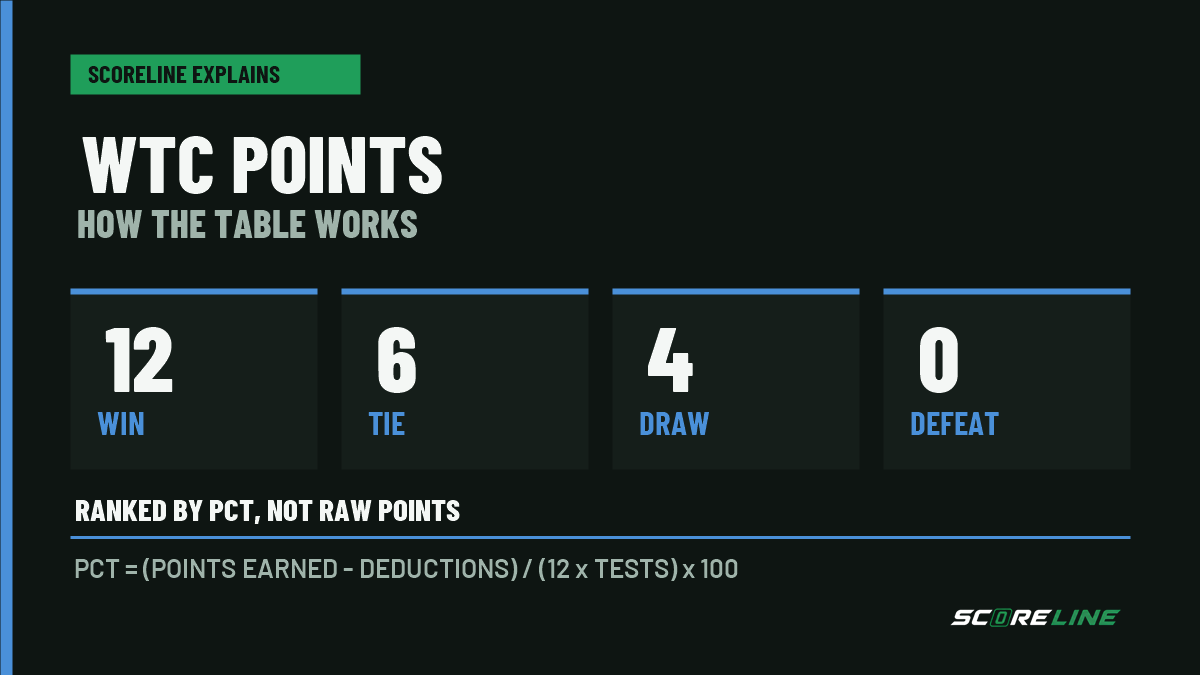
Rain over Gqeberha. Australia a Test up. And every Proteas supporter doing sums on the back of a match ticket. Here is the short answer. In the ICC World Test Championship 2025-27, a win at St George’s Park is worth 12 points, a tie 6, a draw 4 and a defeat nothing at all. That is World Test Championship points explained in one breath. But the table is not ranked on raw points. It is ranked on the percentage of points a team has won from the matches it has played, and a slow over rate can take points away. Which is exactly why a soggy draw this week would be worth so much more than it looks.
The answer first: what this Test is worth
The second Test runs from 18 to 22 October 2026. Australia lead the three-Test series 1-0 after their 214-run win in Durban, which we covered in our Kingsmead first Test report. The weather then did its best to wreck the opening day in Gqeberha. Only 12.2 overs were possible, with South Africa 20 for 2 when play was called off.
None of that changes the prize on offer. Under the ICC World Test Championship 2025-2027 competition regulations, every Test in the cycle pays out the same:
- Win: 12 points
- Tie: 6 points
- Draw: 4 points
- Defeat: 0 points
Simple enough. What trips people up is what happens next.
World Test Championship points explained, step by step
Step 1: every Test carries the same prize
Nine teams play in this cycle. Each one plays six series, three at home and three away, and a series can be anything from two to five Tests long. That is all set out in the ICC media release that launched the 2025-27 cycle and in the regulations.
Crucially, the 12 points are attached to the match, not the series. A Test in a two-match series is worth the same as one in a five-match epic. So this series, with the third Test in Cape Town from 27 to 31 October, offers each side a maximum of 36 points.
Step 2: turn the points into a percentage
This is the number that decides the table. The ICC calls it the points percentage, and most fans call it PCT. The ICC playing conditions for the 2025-27 cycle define it like this:
- Take the points a team has earned.
- Subtract any points deducted for slow over rates.
- Divide by the maximum available, which is 12 multiplied by the number of Tests that team has played.
- Multiply by 100.
That is it. A team that wins every match sits on 100. A team that draws every match sits on 33.33, because 4 is a third of 12. Everyone else lives somewhere in between.
Step 3: the over-rate tax
The minimum over rate is 15 overs an hour. It is worked out at the end of the match, across both of the opposition’s innings, after allowances. The fielding side gets time back for wickets (two minutes each, if the new batter is quick to the crease), drinks breaks (four minutes each), reviews and third umpire referrals, treatment for injured players and other delays it cannot control.
For every full over a team ends up short, it collects a Penalty Over. Each Penalty Over costs one championship point. There are escape hatches, too. If the fielding side has bowled no more than 80 overs in the whole match, no sanction can be imposed. That is worth remembering in a Test already squeezed by rain.
Step 4: draws, ties and lost days
A draw is a draw, whether it comes from two bat-dominated teams or from five days of drizzle. Each side gets 4 points. A lost day does not reduce the points on offer and does not count against either team. The match still counts as one Test played, so it still adds 12 to each side’s maximum available.
Two rare exceptions exist. A match abandoned because the pitch or outfield is rated unfit goes to the visitors as a win. A match that does not take place for reasons the ICC accepts pays no points and is left out of the percentage.
A worked South African example: the Gqeberha Test
Let us put real numbers on it. The ICC State of Play published on 13 October 2026, straight after Durban, had South Africa third on the table. Five Tests played, three won, 36 points, and a PCT of 60.00.
Check the maths. Five Tests at 12 points each makes 60 available. Thirty-six divided by 60 is 0.6, or 60.00. Spot on.
Gqeberha becomes Test number six. The maximum available rises to 72. Here is where each result would leave the Proteas, assuming no over-rate deductions:
- Win: 36 plus 12 makes 48. Divide by 72 and the PCT climbs to 66.67.
- Tie: 36 plus 6 makes 42. The PCT is 58.33.
- Draw: 36 plus 4 makes 40. The PCT is 55.56.
- Defeat: 36 plus nothing stays 36. The PCT falls to 50.00.
Now add the over-rate sting. Say the Test is drawn but South Africa finish two full overs behind the rate. That is 40 minus 2, so 38 from 72, and the PCT drops to 52.78. Two overs, nearly three percentage points gone.
Notice that a draw still nudges the Proteas down from 60.00. Why? A team only holds its PCT steady by earning at least its current percentage from each new Test. Sixty per cent of 12 is 7.2 points, and a draw pays 4. So a draw slips you back a little. A defeat drops you a whole lot more. The gap between those two outcomes is 5.56 percentage points, and in a tight race that is an ocean.
Common misunderstandings
More points means higher on the log. Not in this competition. Teams play different numbers of Tests, so raw totals mislead. On that same 13 October table, England had played 16 Tests and sat on 38.54, while New Zealand had played six and sat second on 72.22. Australia, top on 81.82, had played 11.
A draw keeps your percentage where it is. As the worked example shows, it only does that if your PCT is 33.33. Anyone above that line loses a bit of ground with a draw. Anyone below it gains.
Longer series pay more per Test. That was true once. In the first cycle, from 2019 to 2021, the ICC’s original WTC FAQs explain that each series was worth 120 points, shared across its Tests. A win in a two-Test series paid 60, and a win in a five-Test series paid 24. That system is gone. Today it is 12 per win, flat.
Slow over rates only cost money. They cost table points. The ICC’s 13 October State of Play noted that Pakistan had 11 points docked for slow over rates and that England had also lost points that way.
Why it matters this season
South Africa are the reigning champions. They beat Australia in the 2025 final at Lord’s, and the ICC has confirmed that the next final will be at The Oval in London from 9 to 13 June 2027. Only the top two on the PCT table at the end of the league stage get there.
That is why the Gqeberha weather matters. At 0-1 down, a draw here means South Africa cannot lose the series this week, and a win in Cape Town would still level it at 1-1. It also banks 4 points instead of none, and keeps the PCT at 55.56 rather than 50.00. A draw is not glamorous. In this format it is real currency.
And remember that series wins are the first tie-breaker if teams finish level on PCT. A series levelled 1-1 is not a series won.
For the bigger picture of who needs what to reach The Oval, read our earlier explainer on WTC final qualification scenarios. For the team news and selection talking points, our second Test preview from St George’s Park has you covered. Our Proteas Test team hub and player profiles, including Temba Bavuma, fill in the rest.
Frequently asked questions
How do you work out a team’s World Test Championship percentage?
Add up the points the team has earned, subtract any over-rate deductions, then divide by 12 times the number of Tests it has played. Multiply by 100 and you have the PCT. South Africa’s 36 points from five Tests gives 60.00.
Do teams lose WTC points for a slow over rate?
Yes. The minimum is 15 overs an hour after allowances, and each full over short becomes a Penalty Over that costs one championship point. No sanction applies if the fielding side bowled no more than 80 overs in the match.
Is a WTC win worth more in a two-Test series than in a five-Test series?
Not any more. In the 2025-27 cycle every win is worth 12 points regardless of series length. The old system from the first cycle shared 120 points across each series, which made short-series wins worth more.
What happens to WTC points if rain ruins a Test?
If the match ends without a result, it is a draw and both teams get 4 points. Lost days do not cut the points on offer, and the match still counts as one Test played in the percentage sum.
What decides places if two teams finish level on percentage?
The first tie-breaker is the number of series won. After that comes the higher away points percentage, and then the higher position in the ICC men’s Test team rankings.