


Analysis
Some innings are measured in runs. This one is better measured in what it stopped. Stopped a series from running away. Stopped a home summer from turning sour. Stopped the whispers that start whenever a captain fails twice in the same Test.
Last week the Temba Bavuma captaincy record had a defeat in it for the first time, and his own bat had given Durban almost nothing. In Gqeberha he batted through the rain and out into the sunshine, and by the time he walked off, Australia were looking at a mountain. The scores, session by session, are in our day three report. This piece is about why the innings mattered more than the numbers on the board.
The Temba Bavuma captaincy record, and what Durban did to it
Context first. Bavuma came into this series with a Test captaincy run South African fans had started to take for granted: 11 wins and a draw, and no defeats. That run included the day at Lord’s in June 2025 when South Africa beat Australia in the World Test Championship final. From the stands, his calm had become the team’s calm.
Kingsmead ended the run. Australia won by 214 runs, and the captain made 3 and 1. Within an afternoon, for some, those two scores counted for more than the 11 wins. That is how sport works.
Our Kingsmead column was about the top order as a group. This one is about the man at the end of the queue when the group falls over, because in Gqeberha it fell over again. Before the match Bavuma spoke, as IOL reported, about the side being more ruthless in how it executed and guarding against mental lapses. Those are easy words to say in a press conference. He had to live them.
The rain, the grass and Scott Boland
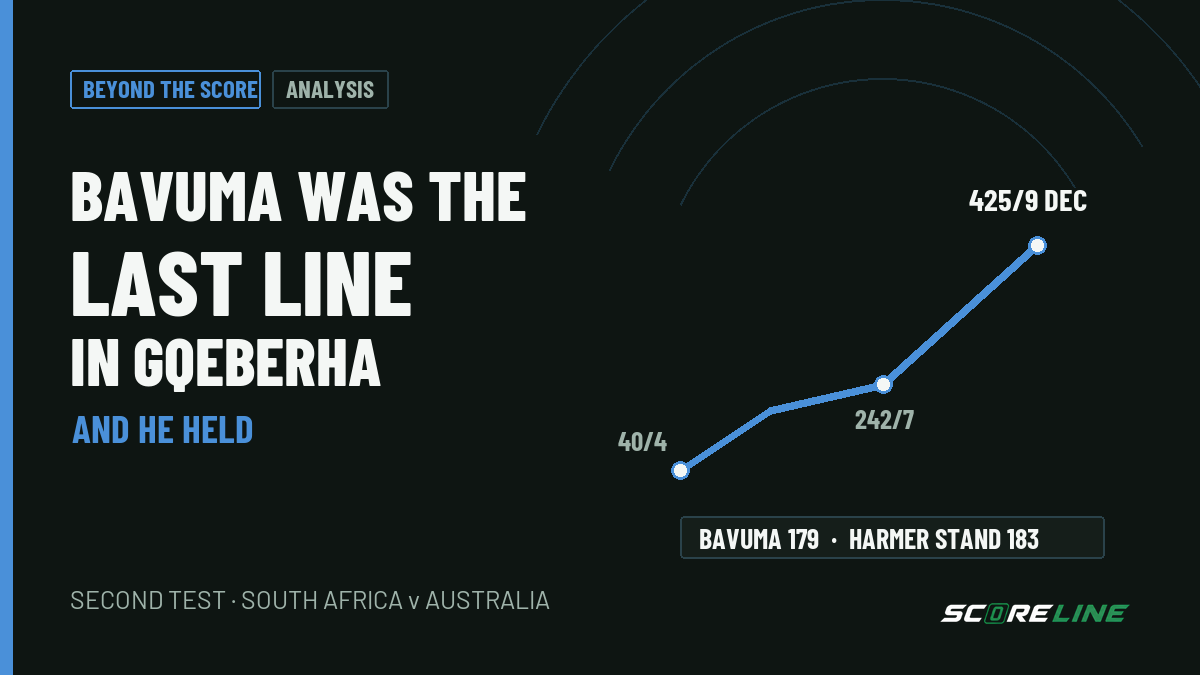
Nothing about the conditions helped. The weather swallowed most of Sunday and Monday. On day two, play did not start until 15:45, after repeated inspections, and when it did Australia had a fresh attack and a pitch with grass on it. South Africa were 40 for 4 before Bavuma found a partner in Ryan Rickelton. How Scott Boland made that short day his own is in our day two report.
That is the part of Bavuma’s innings that will not show up in the highlights. Stop-start cricket is the hardest kind to bat in. You get in, you walk off, you sit in the dressing room watching the covers, you walk back out cold. He did that through the wet days and was still there at stumps on Monday, unbeaten in the forties, with the innings five down behind him.
The key moment: 242 for 7, and the choice to keep going
Every long innings has a point where it could end without anyone blaming the batter. For Bavuma it came on Tuesday afternoon.
Marco Jansen had batted beautifully with him, a stand of 132 that dragged South Africa from trouble into contention. Then the second new ball arrived, Boland struck with it straight away, and Jansen was gone at 242 for 7. Boland now had five. The ball was hard, the specialist batters were gone, and the textbook says the captain farms the strike, takes a few risks and hopes for 300.
Bavuma did not do that. He trusted Simon Harmer, and Harmer repaid him with a Test-best 82. Together they put on 183, the most South Africa have ever added for the eighth wicket in a Test, and turned a decent total into a winning one.
Our view: that stand was the moment of the series so far. At 242 for 7, Australia could still have batted once and had time to press for a result. At 425 for 9 declared, they are batting to survive.
What Bavuma did differently: the insight
Look at what the innings was made of. Bavuma faced 334 balls. He went past his previous best in Tests, brought up a fifth Test hundred and a first against this opponent, and was finally taken by Alex Carey, standing behind the stumps, off Mitchell Starc. The partners changed: Rickelton, then Wiaan Mulder, then Jansen, then Harmer. The captain did not.
The tactical point is about tempo. Jansen’s 85 took 100 balls; the captain’s innings took more than three times as many. Bavuma let his partners set the scoring rate and made sure the innings always had one fixed point. With Jansen he was the anchor while the all-rounder attacked. With Harmer he had a partner happy to stay, and the two simply kept going. That is a captain reading the game from the crease, not a batter chasing his own milestones.
Then the declaration. Bavuma closed the innings as soon as he was out, and Australia had to face a short, nervy spell before the close. Kagiso Rabada found Nic Maddinson’s edge almost at once. A captain who had batted through the rain and into the sunshine still had the presence of mind to squeeze one more advantage out of the evening.
Why this matters: the historical meaning
St George’s Park has given South Africa answers against Australia before. In 2018 South Africa won the Test here by six wickets to level that series, with AB de Villiers making an unbeaten 126 and Rabada taking 11 wickets. Gqeberha has seen Bavuma’s side reach the same point of the series again, one Test down and needing a response, and the response has come from the captain himself.
There is a personal thread too. Every captain gets judged on results. A first defeat as Test captain, with two low scores of his own in the same match, is the kind of week that invites questions about anyone in the job. Bavuma answered them with his best Test score, against the side he beat at Lord’s.
Our view: this does not settle anything for good. Captains are only ever one bad Test from the next debate. But it does say something about the character of this team. When the batting collapsed around him in Durban, the captain fell too. When it collapsed around him in Gqeberha, he refused to.
What happens next
The job is only half done. Australia must bat long on Wednesday, and South Africa need 19 more wickets in the time left to win. A draw would leave Australia 1-0 up with one to play. A win would level the series before the third Test at Newlands, from 27 to 31 October.
The World Test Championship points explainer shows why the difference between those results is bigger than it looks in this cycle, and what this Test meant before a ball was bowled is in our second Test preview. For the man at the centre of it, his Temba Bavuma player page has the career behind the 179.
Frequently asked questions
What is the Temba Bavuma captaincy record in Tests?
Before the first Test against Australia in Durban, Bavuma had won 11 Tests as captain and drawn one, without a defeat. Australia’s 214-run win at Kingsmead in October 2026 was his first loss as South Africa’s Test captain.
How many runs did Temba Bavuma score in the second Test against Australia?
Bavuma made 179 from 334 balls in South Africa’s first innings at St George’s Park. It was his best score in Tests, his fifth Test century and his first against Australia. Alex Carey caught him off Mitchell Starc, and he declared the innings closed immediately.
What record did Bavuma and Simon Harmer set in Gqeberha?
Bavuma and Simon Harmer put on 183, the highest eighth-wicket partnership South Africa have made in Test cricket. Harmer contributed 82, his best Test score, and their stand carried the innings from 242 for 7 to the declaration.
Have South Africa beaten Australia at St George’s Park before?
Yes. In 2018 South Africa won the Test at St George’s Park by six wickets to level that series, with AB de Villiers scoring an unbeaten 126 and Kagiso Rabada taking 11 wickets in the match.
When is the third Test between South Africa and Australia?
The third and final Test is at Newlands in Cape Town from 27 to 31 October 2026. Australia lead the three-match series 1-0 after their win in Durban, with the second Test in Gqeberha still to be decided.