


There is a kind of hope only Test cricket hands you. It builds slowly, over three days of rain and grind, and then it sits on the couch with you overnight asking one cheeky question. Could we actually make them bat again?
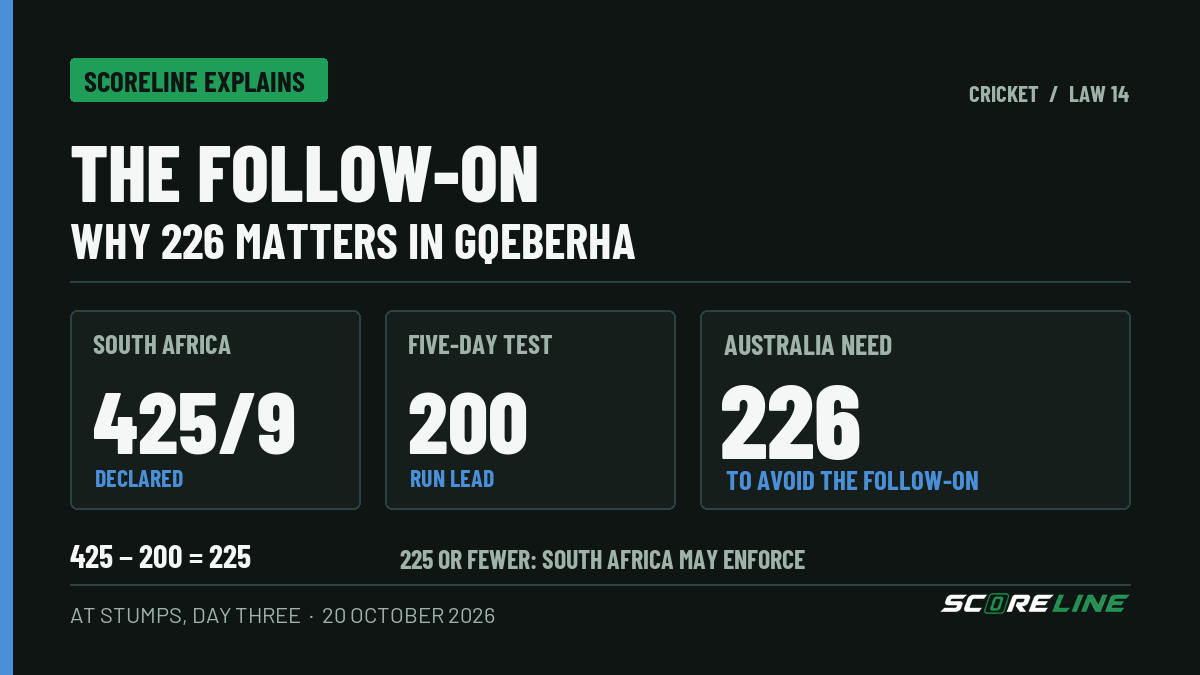
Here is the follow-on rule Test cricket uses, in one breath. In a five-day Test, the side that bats first may send its opponents straight back in if it leads by at least 200 runs after both first innings. It is an option, never an obligation, and the captain of the side that batted first makes the call. In Gqeberha, as at stumps on day three, that captain is Temba Bavuma, and the number Australia must reach to take the choice away from him is 226.
The short answer: 200 runs, and one captain’s choice
The follow-on is Law 14 of the MCC Laws of Cricket. The International Cricket Council (ICC) carries the same clause, in the same terms, in its playing conditions for the current World Test Championship cycle, which govern this series. So there is no gap between the Law and the Test rule book here: the margin, the notice and the lost-day clause all match.
Three things decide whether it is even on the table:
- The match is a two-innings game. Tests are.
- The side batting first leads by at least 200 runs in a match of five days or more.
- That side’s captain chooses to use it.
If any one is missing, the match carries on in the usual order.
The follow-on rule Test cricket plays by, step by step
Step 1: only the side that batted first can enforce it
The option belongs to the team that batted first and leads. The trailing side cannot ask for it, and the umpires cannot impose it.
Step 2: the margin depends on the length of the match
Law 14.1 sets the minimum lead by the scheduled length of the game:
| Length of match | Lead needed to enforce |
|---|---|
| Five days or more (a Test) | 200 runs |
| Three or four days | 150 runs |
| Two days | 100 runs |
| One day | 75 runs |
“At least” matters. A lead of exactly 200 is enough. A lead of 199 is not.
Step 3: the captain tells the umpires, and that is final
The captain must notify the opposing captain and the umpires that the follow-on will be enforced. Once that notice is given, it cannot be changed. There is no walking it back after a look at the weather radar.
Step 4: what happens when a whole day is lost
This is the clause that trips people up. Law 14.3, mirrored in the ICC conditions, says that if no play takes place on the first day, the margin is worked out from the number of days left from the actual start of play. The day on which play first gets going counts as a whole day, whatever time it starts. And play counts as having taken place as soon as the first over has started.
So a Test that loses all of day one effectively becomes a four-day match for this purpose, and the margin drops to 150. A Test that merely starts late on day one does not change at all.
The ICC can also vary the rule for a single match. Wisden reported that for the 2021 World Test Championship final, which had a reserve day, the ICC amended the lost-day clause so the margin fell to 150 only if no play took place on the first two scheduled days. That was a one-off for that final, not the rule in Gqeberha.
Gqeberha, as at stumps on day three
Dated section: the figures below are as they stood at stumps on day three, Tuesday 20 October 2026. Day four is being played today, so the numbers may have moved by the time you read this.
On day one, Sunday 18 October, the start was delayed by about two hours, and only 12.2 overs were bowled before the weather closed in for good. Day two began at 15:45 SAST after more rain and brought 30.4 overs; our day two report from St George’s Park has the detail. That is just 43 overs across the first two days.
Here is why none of that changes the target. Law 14.3 only comes into play when there is no play at all on the first day. There was play on the first day: the first over was bowled, and so were 11 more and two balls. Day one therefore counts as a full day, the Test remains a five-day match for the follow-on, and the margin stays at 200. The two lost hours on Sunday morning, and the lost sessions on Monday, cost time, not runs.
Then came Tuesday. South Africa declared their first innings on 425 for 9, built around 179 from Temba Bavuma. Australia lost Nic Maddinson in the very first over, caught at slip off Kagiso Rabada for a duck. Australia went to stumps on 3 for 1, 422 behind, with two days left.
The arithmetic:
- South Africa’s first innings: 425
- Lead needed to enforce: at least 200
- 425 minus 200 = 225
- If Australia are bowled out for 225 or fewer, South Africa lead by 200 or more and Bavuma may enforce the follow-on
- Australia need 226 to avoid it, which would leave the lead at 199
- From 3 for 1, that is 223 more runs, with nine wickets in hand
So the follow-on target is 226. Reach it and the choice disappears. Fall short and it becomes Bavuma’s decision, and only his.
Why captains often say no
You would think a captain with the chance to make the opposition bat again would grab it every time. For a long stretch, they did. An ESPNcricinfo analysis in July 2017 found that in the 20 years before the Kolkata Test of March 2001, teams enforced the follow-on on 70 of their 77 opportunities. After Kolkata, the rate fell to about 57 per cent.
Kolkata explains a lot. Australia enforced the follow-on at Eden Gardens, VVS Laxman made 281 and Rahul Dravid 180, and India went on to win by 171 runs. It changed how captains think. The same analysis pointed to more practical reasons too: captains resting their bowlers, closer management of bowling workloads, back-to-back Tests in congested schedules, and higher scoring rates.
What a captain weighs up:
- Bowler workload. Enforcing sends the same attack straight back out, with no break. Fresh legs matter, especially with another Test days away.
- The fourth innings. Enforce, and if the opposition bat well second time round, your own batters are the ones chasing on the last day, on the most worn pitch of the match. Bat again instead, and you set the target and they bat last.
- Time. Enforcing saves time, because you do not need a second innings of your own unless they wipe out the deficit. In a rain-shortened Test, that saving can be the difference between a result and a draw.
It is rare for the gamble to backfire, but it does happen. New Zealand beat England by one run at the Basin Reserve in Wellington in February 2023 after following on, only the fourth such win in Test history, after England in 1894 and 1981 and India in 2001.
Common misunderstandings
“Rain cuts the margin.” Only if no play at all takes place on the first day. A late start, or a lost session, changes nothing.
“Avoiding the follow-on means you are safe.” It only takes away one option. The leading side can still bat again and set a target.
“You need a lead of more than 200.” You need at least 200. Exactly 200 is enough.
What it means for the Proteas in this series
The stakes are plain. Australia lead the series 1-0 after their 214-run win in Durban, so South Africa need to win in Gqeberha to level it, and with so much time already lost, every hour counts. That is exactly the situation in which the time saved by enforcing the follow-on looks tempting. Against that, South Africa’s attack has only had Australia’s first innings in its legs so far, and the third Test in Cape Town follows soon after.
The selection calls behind this side are in our second Test preview. And for what a win, a draw or a defeat here is worth in the table, see our World Test Championship points explainer. Whatever happens to the follow-on target, the real number South Africa are chasing is 20 wickets.
Frequently asked questions
What is the follow-on in Test cricket?
The follow-on lets the side that batted first make its opponents bat again immediately if it holds a big enough first-innings lead. In a Test, that lead must be at least 200 runs. It is an option for the leading captain, never automatic.
How many runs does a team need to avoid the follow-on?
Take the first-innings total of the side that batted first, subtract 200 and add one. In Gqeberha, South Africa declared on 425 for 9, so Australia needed 226 to avoid the follow-on, as at stumps on day three.
Who decides whether to enforce the follow-on?
The captain of the side that batted first and leads. He must tell the opposing captain and the umpires, and once he has done so the decision cannot be changed. In the second Test in Gqeberha, if Australia fall short of 226, the choice belongs to Temba Bavuma.
Does rain change the follow-on margin?
Only if no play at all takes place on the first day. Then the margin follows the days left from the actual start, so a Test that loses all of day one uses 150 runs instead of 200. In Gqeberha, play started about two hours late on day one but 12.2 overs were bowled, so the margin stayed at 200.
Has a team ever won a Test after following on?
Yes, but it is very rare. When New Zealand beat England by one run in Wellington in February 2023 after following on, it was only the fourth such win in Test history. England had done it against Australia in 1894 and 1981, and India beat Australia at Kolkata in 2001.