


Analysis
You know the feeling. The kettle has boiled, the cricket is on, and the number in the corner of the screen tells you the series is about to go. On Tuesday morning that number was 110 for 6, with Australia already a Test up.
By Thursday afternoon the same side had won by an innings. Treat this as a Proteas innings win analysis rather than a match report: the scorecard and the captain’s words are in our day-five result report. This piece asks how a team that looked beaten turned the Test inside out at Dafabet St George’s Park, and why three fast bowlers are now the story heading to Cape Town.
How deep the hole was
Start with the context, because it was grim. Australia won the first Test in Durban by 214 runs, so South Africa came to Gqeberha 1-0 down in a three-match series. Rain then swallowed most of the first two days. In the little play that was possible, South Africa slid to 40 for 4 on the second afternoon.
On the third morning Wiaan Mulder fell to Mitchell Starc and it was 110 for 6. Remember that moment. The batter who trudged off at 110 for 6 would finish the match as the bowler who broke Australia’s resistance twice.
The rescue with the bat has had its own column. Temba Bavuma made 179, added 132 with Marco Jansen and then 183 with Simon Harmer, a South African Test record for the eighth wicket. Our first Beyond the Score of the week read that innings at the close of day three. One number is worth adding to it. From 110 for 6, South Africa piled on 315 more runs before the declaration at 425 for 9. The lower order did more than save face. It handed the bowlers a total big enough to attack with.
The key moment: Australia all out for 99
The declaration left Australia a short, awkward spell on the third evening, and Kagiso Rabada removed Nic Maddinson in his first over. That was the first sign. Day four was the turn.
Australia were bowled out for 99. Jansen’s 5 for 33 was his fifth five-for in Tests. Rabada took 2 for 33 and Mulder 2 for 14. Nine of the ten wickets went to those three seamers; Anrich Nortje’s dismissal of Marnus Labuschagne was the only exception. South Africa led by 326, and Bavuma sent Australia straight back in.
That call carried risk. A lot of time had already gone to the weather, and Nortje had gone off during day four and took no further part with the ball, as AP and Sky Sports both reported. So South Africa enforced the follow-on with one fast bowler fewer than they started with. The reasons captains often hesitate there, from tired legs to a long second innings, are covered in our follow-on explainer. Bavuma trusted the attack he had left. It repaid him.
The Proteas innings win analysis comes down to 17 of 20
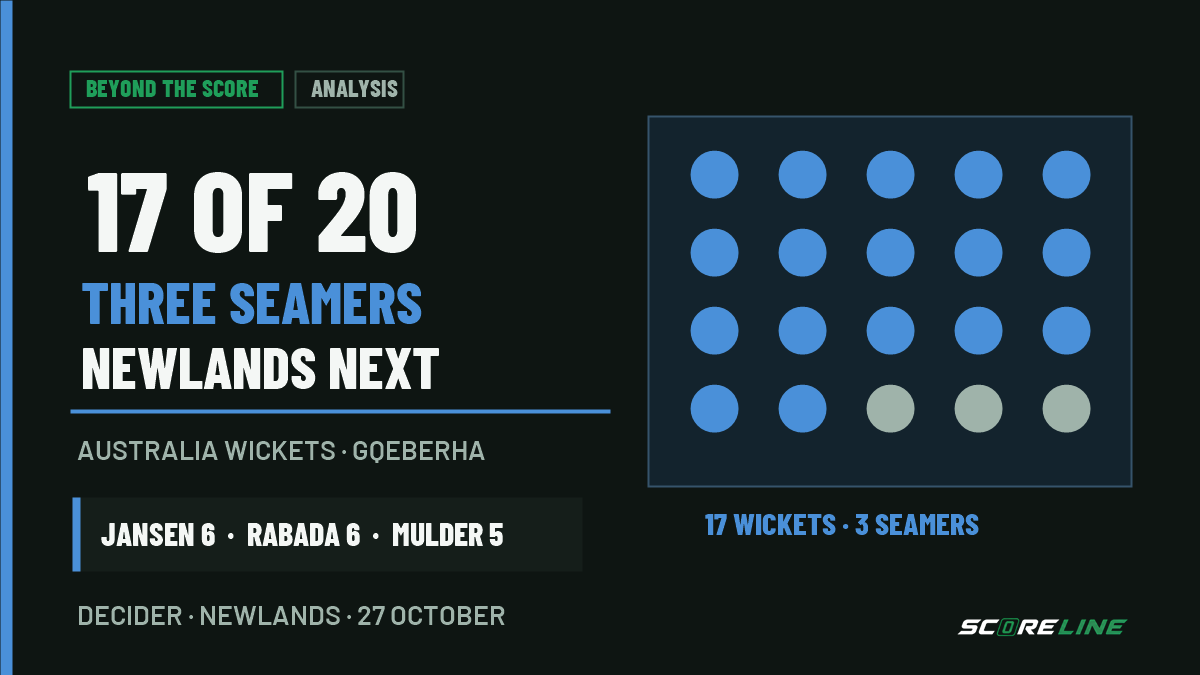
Here is the figure that should frame every plan for Cape Town. Australia lost 20 wickets in the match. Jansen took six of them, Rabada six and Mulder five. Seventeen of the twenty went to three seamers. Harmer’s off-spin claimed two in the second innings and Nortje had the other one.
Each of the three did a different job.
Jansen, the wrecker. His five in the first innings is what made the follow-on possible, and he closed the match himself, with Josh Hazlewood caught at slip by Aiden Markram. Add the 85 he made with the bat and it was the most complete all-round performance of the Test. By TimesLIVE’s count his first-innings five took him to 98 Test wickets, so Hazlewood was number 99.
Rabada, the returning spearhead. He missed Durban while recovering from a hamstring injury. In his first Test of the series he took six wickets, including Steve Smith for 3 on the final afternoon and, later, Mitchell Starc. The attack in Durban did not have him. The attack in Gqeberha did, and six wickets is the measure of what he brought back.
Mulder, the surprise. In Durban he was picked as the second all-rounder, behind Jansen. In Gqeberha he took the two wickets that settled day five: Travis Head for 121, and then nightwatchman Scott Boland, bowled soon after tea for 40 from 166 balls. Boland had batted long enough to make the draw feel possible. Mulder ended that thought, and added Pat Cummins soon after.
The follow-on innings lasted 107.1 overs. That is a long stint in the field for an attack a quick short, against a Head hundred and a nightwatchman who would not budge. The three seamers, with Harmer as the fourth option, still found the wickets when they were needed.
Why it matters: Gqeberha has seen this before
There is history in this comeback, and some of it comes from the same ground. In 2018, South Africa also lost to Australia in Durban and also levelled the series at St George’s Park, with a six-wicket win. Rabada took 11 wickets in that match, Business Day and Wisden reported at the time, and the next stop on that tour was Newlands as well.
The parallel is not exact. That was a four-Test series; this one has three, so Cape Town is a straight decider. Still, it says plenty about Rabada that he has been at the centre of both answers in Gqeberha, eight years apart.
There is more than a series on the line, too. These Tests count towards the World Test Championship, and after Thursday the ICC’s report puts South Africa on 66.67% of available points, with Australia top on 75.00%. South Africa beat Australia in the last final, at Lord’s in 2025. A decider against the same opponent carries that memory with it.
What happens next at Newlands
The third Test starts on Tuesday 27 October at Newlands. Three things will shape how South Africa approach it.
First, Nortje. He did not bowl again in Gqeberha after leaving the field, and we have seen no official update on his fitness for Cape Town. We will not guess at it. What the second Test proved is that Jansen, Rabada and Mulder, with Harmer’s help, can bowl Australia out without him: they did it in the follow-on.
Second, recovery. Rabada has one Test behind him after missing Durban, and only four clear days separate the end of the Gqeberha Test from the start in Cape Town. How fresh the three seamers are on Tuesday morning may matter as much as any selection.
Third, Australia. The ICC reports that Cummins will wait until the squad reaches Cape Town before settling his team, with Cameron Green and Josh Inglis expected to be available. A different Australian batting order will test whether 17 of 20 can happen twice.
Our view: the batting saved this Test, but the bowling won it, and bowling wins series. If Jansen, Rabada and Mulder take the field together at Newlands, South Africa have the attack to win the decider. A home summer that looked lost in Durban could end with a series win in Cape Town.
Frequently asked questions
How did the Proteas come back to win the second Test?
South Africa were 110 for 6 in their first innings and recovered to 425 for 9 declared. Their bowlers then dismissed Australia for 99 and, after the follow-on, for 295. The margin was an innings and 31 runs.
Who took the most wickets for South Africa in Gqeberha?
Marco Jansen and Kagiso Rabada took six wickets each in the match and Wiaan Mulder took five. Simon Harmer took two and Anrich Nortje one. The three seamers shared 17 of Australia’s 20 wickets.
Why did South Africa enforce the follow-on against Australia?
Australia were bowled out for 99 in reply to 425 for 9 declared, a deficit of 326, which gave Temba Bavuma the option. He took it even though Nortje had gone off on day four and could not bowl again. The remaining bowlers completed the job on day five.
When does the third Test against Australia start at Newlands?
The third and deciding Test starts at Newlands in Cape Town on Tuesday 27 October and is scheduled to end on 31 October. The series is level at 1-1.
Have South Africa levelled a series against Australia at St George’s Park before?
Yes. In 2018 South Africa lost the first Test to Australia in Durban, then won at St George’s Park by six wickets to level the series. Rabada took 11 wickets in that match, and the series moved on to Newlands.