


Some numbers arrive with a story already attached. Six for 72 is one of them. Read it cold and you picture a great fast bowler running in all day, leaning on a batting line-up over after over until it finally gave way. That is not what happened in the Proteas Newlands first innings, and the gap between that picture and the ball-by-ball record matters, because this is a series decider and South Africa will have to bat again.
The outline is simple enough: 158 without loss, then 329 all out. Our day-one report tells the story of Tuesday as it unfolded. This piece goes back through ESPNcricinfo’s scorecard, fall of wickets and ball-by-ball commentary to ask three narrower questions. What did the second new ball really do? How did Mitchell Starc’s six wickets actually arrive? And what does the lower order’s contribution look like once you take it apart?
| The innings in numbers | |
|---|---|
| Match | South Africa v Australia, third Test, Newlands, 27 to 31 October 2026 |
| Toss | Australia won it and chose to bowl |
| Total | 329 all out in 82.3 overs |
| Opening stand | 158 (Marques Ackerman 95, Aiden Markram 78) |
| First slide | 158 for 0 to 232 for 6 |
| Seventh-wicket stand | 95 (Ryan Rickelton 42, Marco Jansen 52) |
| Second slide | 327 for 6 to 329 all out |
| Best bowling | Mitchell Starc 16.3-2-72-6 |
| Source | ESPNcricinfo scorecard and ball-by-ball |
The number: six for 72
On the scorecard, Starc’s line is 16.3 overs, two maidens, 72 runs, six wickets. Nathan Lyon took two, and Josh Hazlewood and Cooper Connolly one each. Pat Cummins, the captain, went wicketless in 18 overs.
The obvious reading is that Starc was the difference: the senior quick who never let South Africa settle, chipping away until the innings broke. Put that next to the total and the conclusion seems to write itself. A side that was 158 without loss should make far more than 329, so the rest of the order must have folded under sustained pressure from one bowler.
There is something in that. But almost every part of it is the wrong shape.
What actually happened: six wickets in nine balls
Starc bowled 99 deliveries. Six of them took wickets, and those six came in two short bursts.
The first was in the 57th over. With South Africa 232 for 4, he had David Bedingham caught by Hazlewood with the second ball, and Wiaan Mulder caught behind by Alex Carey two balls later. Two wickets in three deliveries, with the score stuck on 232.
The second came with the second new ball. Australia took it the moment it was due, at the start of the 81st over, with South Africa on 325 for 6. Starc’s first over with it went single, single, dot, then Rickelton leg before, then a leg bye, then Jansen bowled. ESPNcricinfo’s commentary describes the ball that beat Jansen as an inswinger at 143km/h.
Cummins bowled the next over at Simon Harmer: six dots and a wide, the only run scored between the eighth and ninth wickets. Then Starc bowled Gerald Coetzee first ball and had Kagiso Rabada leg before two balls later, after Rabada had survived the hat-trick delivery.
Add it up and the split is stark. Before the second new ball, Starc had bowled 15 overs for 70 runs and two wickets. With it, he bowled nine balls, conceded two runs and took four wickets. Of Australia’s three main fast bowlers, he finished with the highest economy rate: 4.36 an over, against Cummins’s 4.05 and Hazlewood’s 3.93.
None of that makes Starc’s day less impressive. Nine balls of that quality, at that moment, decide Test matches. It does mean 6 for 72 is not a description of a siege. It is two raids, separated by 24 overs in which he did not take a wicket.
Proteas Newlands first innings: where it really turned
If Starc did not start the collapse, who did? The fall of wickets answers it.
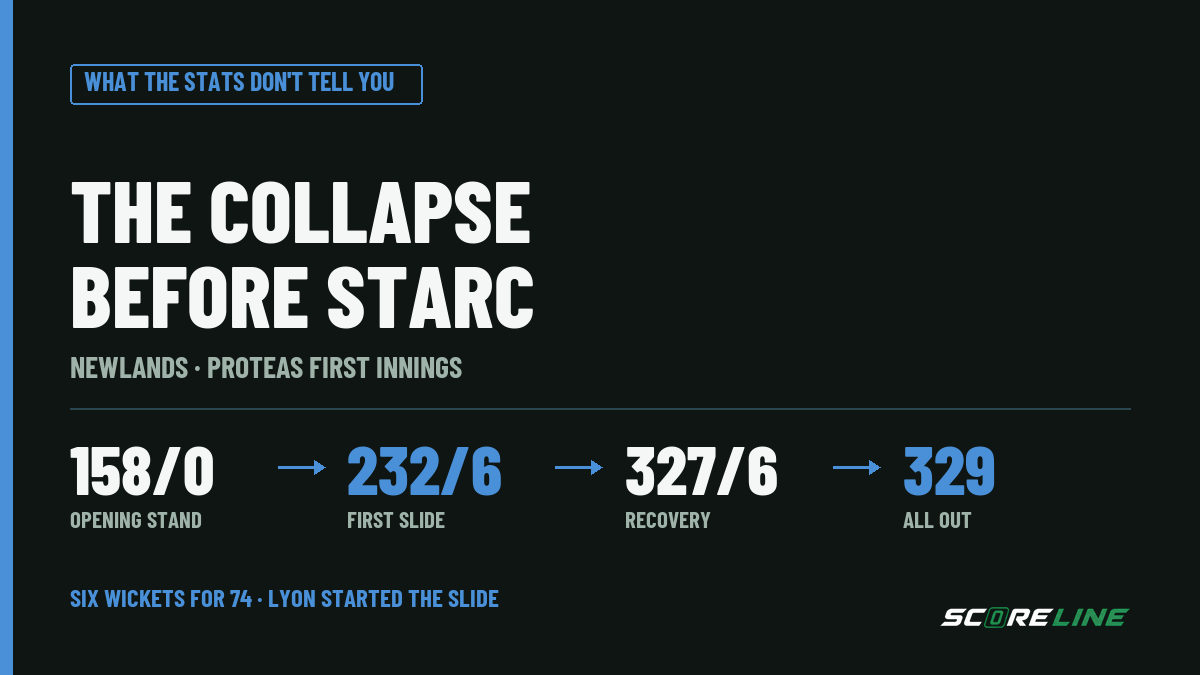
The first wicket did not fall until the fourth ball of the 32nd over. The opening stand of 158 came at close to five an over, with Ackerman scoring at better than a run a ball: 95 from 94 deliveries, with 12 fours and two sixes. Then the slide began, and Starc’s name is not on the first four wickets.
Lyon broke the stand, Ackerman stumped by Carey. Hazlewood removed Markram for 78, caught by Starc. Lyon bowled Temba Bavuma third ball for a duck. Connolly had Matthew Breetzke leg before for 2. From 203 for 1, South Africa had gone to 232 for 6: five wickets for 29 runs.
Measured from the opening stand, the first slide was six wickets for 74 in 25 overs. That is the part of the innings that turned a big total into a fair one, and Lyon is the quiet thread through it. He bowled more overs than anyone, 23, at 3.08 an over, the most economical figures in the attack. On a scorecard that shouts Starc, the off-spinner who took the first wicket and the captain’s wicket barely registers.
Our view: the collapse that should worry South Africa most is the first one. Losing your last four wickets for two runs to a world-class left-armer with a hard new ball is one of the hazards of Test cricket. Losing six for 74 to a mix of spin and seam, on a pitch where your openers had just put on 158, is the stretch the dressing room will want back. Ackerman, as our day-one report recorded, accepts the risk that comes with the way he bats; the harder questions are for the batters who followed him.
The lower order: 95 together, then almost nothing
Rickelton, batting at six, and Jansen, at eight, added 95 for the seventh wicket. It was the second-biggest stand of the innings and lasted 24 overs, and Australia could not separate them with the old ball. Jansen’s 52 came from 71 balls, Rickelton’s 42 from 83.
Around them, the returns were thin. Mulder, at seven, made 0 from two balls. Harmer, Coetzee and Rabada, at nine, ten and eleven, made no runs between them from ten balls. Jansen’s 52 was every run scored by numbers eight to eleven. Six of South Africa’s eleven batters made two runs between them; extras made ten.
That looks like a tail that did not turn up. The ball-by-ball suggests a more forgiving reading. All four wickets that fell to the second new ball were bowled or leg before: Starc was attacking the stumps, and the batters left standing had no time to get in. The stand of 95 ended on the fourth ball with the new ball, not with a loose stroke after a long partnership, and the whole new-ball passage lasted 15 legal deliveries.
Why the gap between the numbers and the reality exists
Scorecards are built to add things up, and adding up hides order. A bowling line of 6 for 72 puts all 99 of Starc’s deliveries into one figure, when the damage was done in nine of them. A total of 329 sits next to an opening stand of 158 and invites the reader to blame everyone below the openers equally, when a stand of 95 from the six and eight carried the innings out of the wreck of 232 for 6.
The timing is invisible too. The second new ball was due at 80 overs, and Australia took it at once with the seventh-wicket pair well set. It is a routine decision, and it worked exactly as planned. Any innings that reaches the second new ball seven down asks numbers nine, ten and eleven to face the best fast-bowling conditions of the day.
Starc himself said after play that he would gladly have wiped Australia’s first session from the record. The figures show why: until the 32nd over Australia had no wicket, and what changed the innings was not one bowler’s relentlessness but soft dismissals in the middle and a few perfect balls at the end.
What it means next
Of the two slides, only one is fully in South Africa’s control. A new ball in Starc’s hands will always be a threat. The run from 158 for 0 to 232 for 6, though, came against an older ball, with Lyon at one end, and it is the passage the Proteas’ second-innings plan has to fix. Bavuma, Breetzke and Mulder faced 17 balls between them for two runs.
The bowlers carry the other half of the job. It was South Africa’s attack that won the second Test in Gqeberha by an innings, as our St George’s Park report showed, and 329 is now the number they defend. Whether it is enough is for the days still to come in a decider our series preview set up. What the first innings already tells us is that the headline figure is not where South Africa’s problems began.
Frequently asked questions
What did the Proteas score in their first innings at Newlands?
South Africa were bowled out for 329 in 82.3 overs after Australia won the toss and chose to bowl. Marques Ackerman made 95 and Aiden Markram 78 in an opening stand of 158.
How many wickets did Mitchell Starc take with the second new ball at Newlands?
Four, for two runs in nine deliveries. Australia took the new ball as soon as it was available, at the start of the 81st over, with South Africa on 325 for 6. Starc finished with 6 for 72.
Who started the Proteas’ collapse at Newlands?
Not Starc. The first four wickets went to Nathan Lyon (two), Josh Hazlewood and Cooper Connolly, and Starc’s first wicket was the fifth, at 232. From 158 without loss, South Africa lost six wickets for 74 runs in 25 overs.
How did the Proteas’ lower order bat at Newlands?
Ryan Rickelton and Marco Jansen added 95 for the seventh wicket, the second-biggest stand of the innings. After that, numbers nine to eleven made no runs from ten balls, and the last four wickets fell for two runs.
Is the Newlands Test the decider in the Proteas’ series against Australia?
Yes. The third Test at Newlands, from 27 to 31 October 2026, is the last of the series, and the teams went into it level. This analysis covers South Africa’s first innings only.