


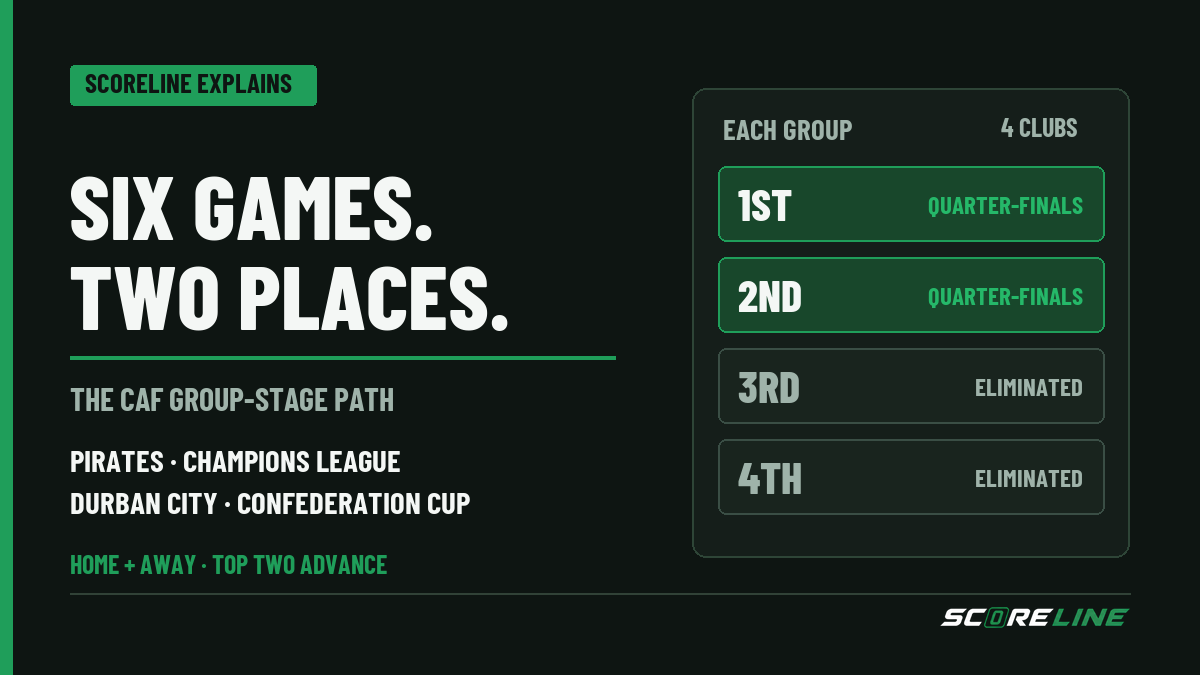
Draw day in Cairo hands Orlando Pirates and Durban City names to fear, or names to fancy. The shape of the road ahead, though, was fixed long before anyone touched a ball. So here is the CAF group stage explained, whoever ended up where: 16 clubs in the Champions League and 16 in the Confederation Cup, each competition split into four groups of four. Every club meets its three group rivals twice, once at home and once away, between late November and late January. Finish first or second and you are in the quarter-finals. Finish third or fourth and your African season is over.
| Quick facts | |
|---|---|
| Competitions | TotalEnergies CAF Champions League and TotalEnergies CAF Confederation Cup, 2026/27 |
| Group stage | 16 clubs in each competition, four groups of four |
| Matches | Six per club, home and away against each group rival |
| Who goes through | Group winners and runners-up, eight clubs per competition |
| Group matchdays | 27 November 2026 to 24 January 2027 |
| Quarter-finals | 26 to 28 February and 5 to 7 March 2027 |
| South Africa’s clubs | Orlando Pirates (Champions League), Durban City (Confederation Cup) |
| Draws | Scheduled for Wednesday 28 October 2026, Cairo: Confederation Cup 13:00 SAST, Champions League 14:00 SAST |
CAF scheduled both draws for Wednesday 28 October at the Egypt Football Association headquarters in Cairo, shown live on CAF TV. Who landed in which group is a separate story, and you can follow the draw and the groups on ScoreLine. This page is about the rules, which hold whoever is drawn where.
The CAF group stage explained, step by step
Step one: who is in it. The group stage is the reward for surviving the preliminary rounds. In each competition, the 16 clubs that won their second preliminary round ties, played across two weekends from 16 to 25 October, go into the draw. Those 16 are the whole field.
Step two: the seeding. The draw is not a free-for-all. CAF’s regulations seed it on the confederation’s own club ranking, which counts results in CAF competitions over the previous five seasons. Last season CAF put the clubs into ranked pots and drew one at a time into the groups, so the strongest-ranked sides were spread out. This page does not guess at this season’s pots, which CAF had not published when we checked.
Step three: six matchdays. One calendar covers both competitions. CAF gives a three-day window for each round rather than a fixed date for every match:
| Matchday | Window |
|---|---|
| 1 | 27 to 29 November 2026 |
| 2 | 4 to 6 December 2026 |
| 3 | 18 to 20 December 2026 |
| 4 | 8 to 10 January 2027 |
| 5 | 15 to 17 January 2027 |
| 6 | 22 to 24 January 2027 |
Notice the shape. Three rounds before Christmas, a break over the festive season, then three rounds in the space of three weekends in January. A club that starts slowly has very little time to recover once the new year begins.
Step four: the table. Three points for a win, one for a draw, nothing for a defeat. The most any club can collect is 18.
Step five: when clubs finish level. This is the rule that catches people out. CAF does not go to overall goal difference first. When clubs are level on points, the games between those clubs come first: the points they took off each other, then the goal difference in those games. When three or more are tied, that becomes a mini-league of their matches against one another. Only if the head-to-head record cannot separate them does goal difference across all six group matches count, followed by goals scored. Drawing of lots is the last resort.
Step six: the quarter-finals. The four group winners play the four runners-up, in a draw made after the group stage, and two clubs from the same group cannot meet again at that point. The runner-up hosts the first leg, which means the group winner plays the return at home. Each quarter-final is two legs, on 26 to 28 February and 5 to 7 March 2027. The semi-finals follow in April, and the finals of both competitions fall in a window from 9 to 31 May 2027. How a two-legged tie is settled when the aggregate is level, away goals included, is set out in our guide to the preliminary rounds.
What Orlando Pirates need in the Champions League
Orlando Pirates go into the draw as South Africa’s only club left in the Champions League. They earned it emphatically, a 5-0 aggregate win over African Stars of Namibia, and the club itself spoke of putting the ghosts of the previous campaign to rest.
The job from here is simple to state and hard to do: be one of the top two in a group of four. A worked example shows why nobody can promise a number. Say Pirates win all three home games and lose all three away. That is nine points. In one group nine might be plenty; in another, two clubs could pass it. And if Pirates finish level with a rival, the two games against that club decide it before anything else does. That is why the results against the closest rivals carry extra weight, and why the margin of a thumping win over the bottom side counts for less than many fans assume.
There is also a reason to want first rather than second. A group winner meets a runner-up from another group in the quarter-finals and plays the second leg at home. The prize at the very end is USD 6 million for the champions, according to CAF, and the Champions League winner takes part in the next edition as well.
Pirates know what that last step feels like. They won the 1995 African Cup of Champions Clubs, the competition that later became the Champions League, beating ASEC Mimosas of Côte d’Ivoire over two legs in the final.
What Durban City need in the Confederation Cup
The arithmetic is identical for Durban City. The story around it is completely different.
This is the Citizens’ first continental campaign, and their first group stage. Their Nedbank Cup win the season before opened the door, and under head coach Eric Tinkler they walked through it with a 6-1 aggregate win over AS Port Louis 2000 of Mauritius, sealed by a 3-0 win on the island. Now comes the group stage proper: six matches before the end of January.
The target is the same: top two from four. The same head-to-head rules apply, the same quarter-final draw, the same advantage of hosting the return leg for clubs who win their group. The Confederation Cup champions collect USD 4 million, CAF says. For a club that played its first CAF match only this season, simply reaching February would be a landmark.
Common misunderstandings
“Goal difference decides it.” Not first. The results between the clubs who are level come first, and goal difference across the whole group only counts after that.
“Second place is as good as first.” Both go through, but they are not equal. Winners face a runner-up and play the second leg of the quarter-final at home.
“The groups are done by Christmas.” Only half the matchdays are. Three matchdays are played before the festive break, and the last three are in January, the final round on 22 to 24 January.
“Sundowns or Chiefs could still come in.” They cannot. The 16 places in each draw went to the clubs that won their second preliminary round ties. The holders, Mamelodi Sundowns, were knocked out by Wiliete of Angola: goalless away, 1-1 at Loftus Versfeld, and the Angolans’ away goal settled it. Kaizer Chiefs took their home leg against Red Arrows of Zambia 1-0, which only levelled the Confederation Cup tie at 1-1, and then lost the penalties 3-2.
“The draw fixes every date.” The draw sets the groups. CAF’s calendar gives each matchday as a window of three days, so the exact day and kick-off time of each game is a separate announcement.
Why it matters this season
South Africa started this African season with four clubs in the preliminary rounds: two in each competition, Sundowns and Pirates chasing the Champions League, Chiefs and Durban City the Confederation Cup. Two remain. One is the reigning league champion carrying the country’s hopes in the bigger competition alone. The other is a debutant, still in its first continental campaign.
That is the beauty of the group stage. It is long enough for a team to have a bad night and recover, and short enough that a bad week in January can end everything. Six games, two places, one table. Learn the tie-breakers now; there is a good chance we will need them on the final weekend.
Frequently asked questions
How does the CAF group stage work?
Each competition has 16 clubs, drawn into four sections of four. Every club meets the other three in its group twice, at home and away, which makes six matches between 27 November 2026 and 24 January 2027. A win is worth three points and a draw one.
How many teams qualify from each CAF Champions League group?
Two. The top two in every group go through, so eight clubs make the quarter-finals. The same applies in the Confederation Cup, and the third and fourth-placed clubs are eliminated.
What happens if teams are level on points in a CAF group?
CAF looks first at the matches between the clubs who are level: the points they took off each other, then goal difference in those games, as a mini-league when three or more clubs are tied. Overall goal difference and goals scored across the group only count if the head-to-head record cannot separate them. Drawing of lots is the last resort.
When are the CAF Champions League quarter-finals?
The first legs are scheduled for 26 to 28 February 2027 and the return legs for 5 to 7 March 2027. Group winners meet runners-up, and the runners-up host the first leg.
When is the CAF group stage draw?
CAF scheduled both draws for Wednesday 28 October 2026 at the Egypt Football Association headquarters in Cairo. The Confederation Cup draw was set for 13:00 SAST and the Champions League draw for 14:00 SAST, live on CAF TV.