


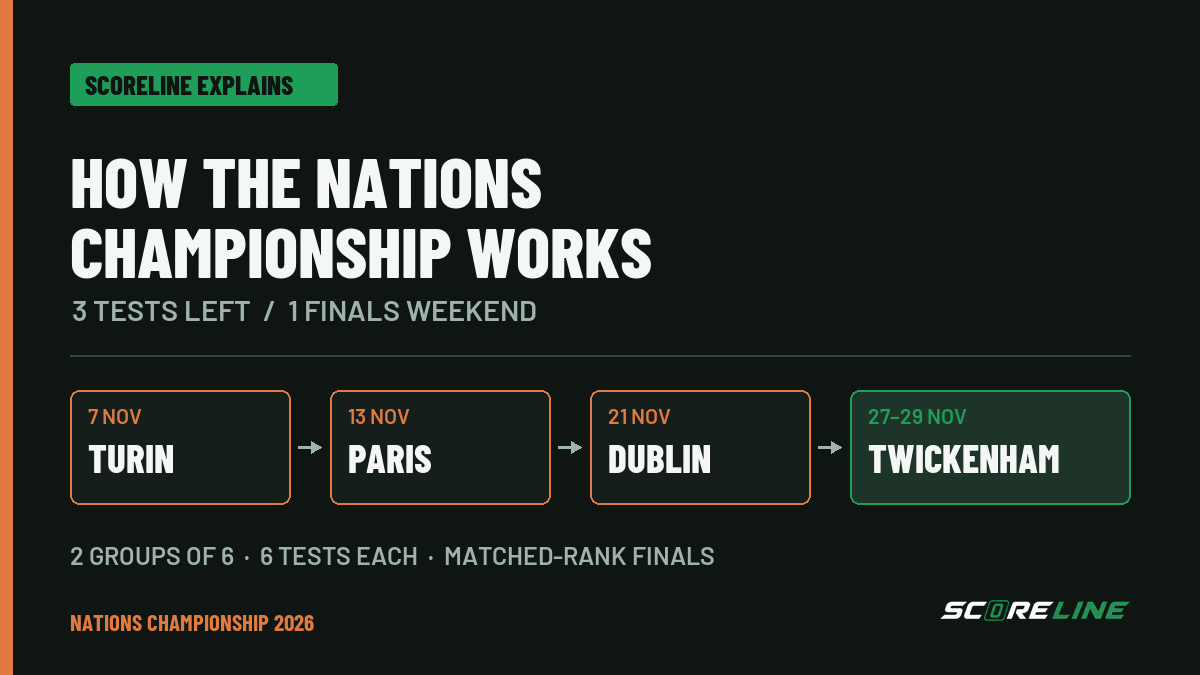
Fifteen points from a possible fifteen. That is what the Springboks carried out of July, and on Saturday in Turin they start the job of turning it into a place in the final. If you are still working out how the Nations Championship works, here it is in one breath: twelve teams in two groups of six, North against South. Every team plays the six sides in the other group once, three Tests in July and three in November. Then the two tables are laid side by side, and on finals weekend at Twickenham each team meets the side that finished in the same spot in the other group. First against first decides the champion.
| Quick facts | |
|---|---|
| Competition | Nations Championship, first edition, played every two years |
| North | England, France, Ireland, Italy, Scotland, Wales |
| South | South Africa, New Zealand, Australia, Argentina, Japan, Fiji |
| Points | 4 for a win, 2 for a draw, plus bonus points (see step three) |
| South Africa after July | First in the South: three wins, 15 points, points difference +81 |
| Round four | Italy v South Africa, Saturday 7 November, Allianz Stadium, Turin, 13:40 SAST |
| Round five | France v South Africa, Friday 13 November, Stade de France, Saint-Denis, 22:10 SAST |
| Round six | Ireland v South Africa, Saturday 21 November, Aviva Stadium, Dublin, 18:40 SAST |
| Finals weekend | 27 to 29 November, Allianz Stadium, Twickenham, London |
One warning first: there are two Allianz Stadiums in this story. Saturday’s is Juventus’s ground in Turin. The finals are at Twickenham in London. Same name on the gate, very different stakes.
How the Nations Championship works, step by step
Step one: two groups of six. World Rugby describes the field as the Six Nations and Rugby Championship teams, plus Fiji and Japan. The six European unions form the North. South Africa, New Zealand, Australia, Argentina, Japan and Fiji form the South. Six Nations Rugby and SANZAAR created the competition, and it is played every two years inside the Test windows that already existed in July and November.
Step two: you never play your own group. This is the part that surprises people. Each team meets all six teams from the other group once, and nobody from its own. In July the Boks played all three of their matches at home. In November the southern sides go north, so the next three are all away: World Rugby lists 18 matches in its Northern Hemisphere Series between 6 and 21 November.
Step three: the points. Four for a win, two for a draw. Bonus points come on top. Rugby Australia’s competition explainer, backed by SuperSport’s, says a team earns one for scoring four or more tries; the explainers published by Rugby Australia and New Zealand Rugby both give one for losing by seven points or fewer. World Rugby’s table is consistent with that. A perfect group stage is worth 30 points. South Africa have banked exactly half.
Step four: the rankings. After six rounds, each group is ranked from first to sixth. From that moment the points stop being a total and become a position, and the position decides who you play in London.
Step five: finals weekend. All six finals are played at the Allianz Stadium, Twickenham, from Friday 27 to Sunday 29 November, in three double-header sessions. Sixth in the North plays sixth in the South, fifth plays fifth, and so on up to the Grand Final between the two group winners. SA Rugby says points are on offer in all six, and that a winning hemisphere is crowned as well as a champion team. The host stadium says each team’s day will be fixed closer to the finals, depending on results, so nobody can yet tell you which day the Boks play.
A worked South African example: July
The Boks opened at 10bet Ellis Park, home of the Lions, on Saturday 4 July and beat England 45-21, scoring seven tries to three. A week later at Loftus Versfeld, the home of the Bulls, they were level 14-14 at half-time before pulling away to beat Scotland 42-28. Then on 18 July, at Hollywoodbets Kings Park, where the Sharks play, they kept Wales scoreless and won 43-0, again with seven tries.
Three wins is 12 points. World Rugby’s table adds three bonus points, one per match: the Boks scored at least four tries every time. That makes 15, with 130 points scored and 49 conceded: +81.
Here is how both tables stood when the July leg ended, according to World Rugby:
| South | W | L | Diff | Pts | North | W | L | Diff | Pts |
|---|---|---|---|---|---|---|---|---|---|
| South Africa | 3 | 0 | +81 | 15 | France | 2 | 1 | +41 | 12 |
| New Zealand | 3 | 0 | +51 | 15 | Scotland | 2 | 1 | +11 | 11 |
| Australia | 1 | 2 | +29 | 8 | England | 2 | 1 | +48 | 10 |
| Argentina | 1 | 2 | -2 | 7 | Ireland | 2 | 1 | -1 | 10 |
| Japan | 1 | 2 | -26 | 4 | Wales | 1 | 2 | -42 | 5 |
| Fiji | 0 | 3 | -96 | 0 | Italy | 0 | 3 | -94 | 0 |
Notice the top of the South. New Zealand also took 15 from three wins, so the old rivals are level. South Africa sit first on World Rugby’s table, with more tries (20 to 18) and a better points difference. A lead, but a thin one.
What the Springboks need from Turin, Paris and Dublin
Only first in the South leads to the Grand Final. With New Zealand level, every bonus point won or missed could decide it. New Zealand’s own November includes England at Twickenham on Saturday 21 November, the day the Boks finish in Dublin.
Italy, Saturday 7 November, Allianz Stadium, Turin, 13:40 SAST. On paper, the gentlest of the three. Italy lost all three July matches, scoring 37 points and conceding 131, and sit bottom of the North without a point. The Boks won 32-14 in Turin a year ago. In our view a win alone is not the target. Five points is. Four points without the bonus would hand New Zealand ground they may not give back.
France, Friday 13 November, Stade de France, Saint-Denis, 22:10 SAST. The heavyweight. France lead the North on 12 points, so both tables feel this one: a South African win adds to South Africa’s total and denies the leaders of the other group. If both finish first, Paris is a preview of the Grand Final. The Boks won in Paris last November, but a Friday night at the Stade de France is never simple. A defeat by seven points or fewer would still be worth a bonus point, which is why the last ten minutes matter even when the game looks gone.
Ireland, Saturday 21 November, Aviva Stadium, Dublin, 18:40 SAST. The last round, six days before finals weekend. Ireland are fourth in the North on 10 points. The Boks won 24-13 in Dublin last November, which SA Rugby’s report called the end of a Dublin hoodoo. The group stage ends that day, and with it the guesswork.
Who wears the jersey across those three weeks is a separate question, and our squad analysis covers the selection in full.
Common misunderstandings
“The Boks could meet the All Blacks in the final.” They cannot. South Africa and New Zealand share a group, and the finals only pair a northern team with a southern one. Neither can settle the race for first head to head.
“Finals weekend is a knockout.” Not in the usual sense. All twelve teams play once more in London, and each game pairs teams that finished in the same position in their groups.
“The final is on Sunday 29 November.” That has not been confirmed. The host venue says each team’s day depends on results and will be set nearer the time.
“Margins don’t matter.” Wins matter most, but four tries and a close defeat both earn bonus points, and the two leaders in the South cannot be split on points at all.
Why it matters this season
Until this year, a Springbok Test in the north in November stood on its own. This year the Boks travel with a table in their luggage, and the fifteen points from July are only a head start.
There is also the small matter of history. This is the first Nations Championship, so whoever wins at Twickenham will be its first champions, a line nobody can ever take away. Our Springboks page has the long version of that story, from 1891 to four World Cups. The next chapter starts in Turin on Saturday.
Frequently asked questions
How does the Nations Championship work?
Twelve teams are split into a northern group (the Six Nations sides) and a southern group (South Africa, New Zealand, Australia, Argentina, Japan and Fiji). Each team plays all six teams in the other group once, three Tests in July and three in November. The teams are then ranked from first to sixth in each group, and on finals weekend each plays the team in the matching position from the other group.
How many points do you get for a win in the Nations Championship?
A win is worth four points and a draw two. Teams also earn a bonus point for scoring four or more tries in a match, according to Rugby Australia’s explainer (SuperSport says the same), and one for losing by seven points or fewer, according to the explainers published by Rugby Australia and New Zealand Rugby. World Rugby’s table is consistent with that. On that system, 30 is the most any team can collect from the six group matches.
When and where is the Nations Championship final?
Finals weekend is from Friday 27 to Sunday 29 November 2026 at the Allianz Stadium, Twickenham, London. The Grand Final is the meeting of the two group winners. The host venue says the day of each match will be set closer to the finals, depending on results.
When do the Springboks play Italy, France and Ireland?
South Africa play Italy at the Allianz Stadium in Turin on Saturday 7 November (13:40 SAST), France at the Stade de France on Friday 13 November (22:10 SAST) and Ireland at the Aviva Stadium in Dublin on Saturday 21 November (18:40 SAST).
Can the Springboks play the All Blacks in the Nations Championship?
No. South Africa and New Zealand are both in the southern group, and teams never play their own group, either in the group stage or on finals weekend. After July the two were level on 15 points, with South Africa first on World Rugby’s table.