

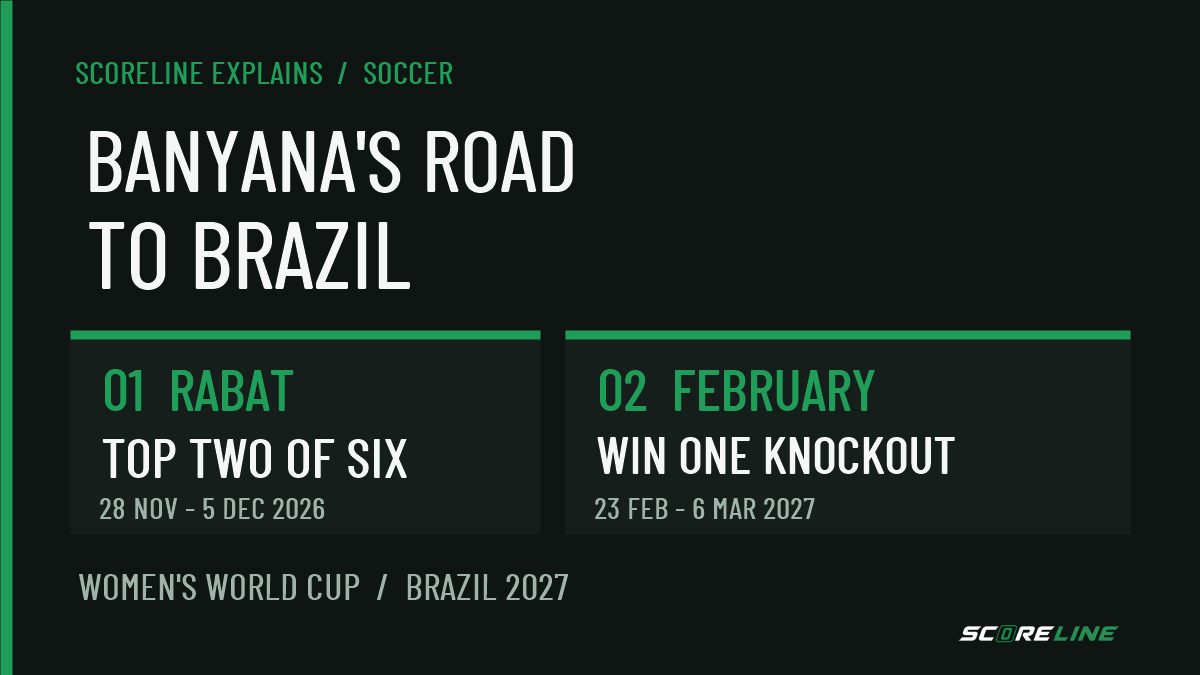
Two steps. That is all that stands between Banyana Banyana and a third Women’s World Cup, and neither of them is easy. Here is the Banyana World Cup playoff explained in one breath: finish in the top two of a six-team mini-league in Rabat between 28 November and 5 December, then win a single knockout match in February 2027. Do both and South Africa are going to Brazil.
Miss either, and the wait for the next World Cup starts again. That is why the next month matters so much to Desiree Ellis and her squad.
| Quick facts | |
|---|---|
| Tournament | FIFA Women’s World Cup 2027 play-off tournament |
| First stage | Preliminary phase, 28 November to 5 December 2026 |
| Venue | Mohammed VI Football Complex, Rabat, Morocco |
| Teams | South Africa, Chinese Taipei, Ecuador, Ghana, Papua New Guinea, Uzbekistan |
| Banyana’s opponents | Chinese Taipei, Ecuador, Uzbekistan |
| Who goes through | The top two |
| Final stage | Single knockout matches, window of 23 February to 6 March 2027 |
| World Cup places at stake | Three |
| The finals | Brazil, 2027 |
How Banyana ended up in the play-offs
This was never meant to be the route. Africa’s automatic places went to the four semi-finalists at WAFCON 2026 in Morocco, as SAFA set out before the knockout rounds. Banyana lost their quarter-final to the hosts, Morocco, and with it the direct ticket. Cameroon, Malawi, Algeria and Morocco are the African sides already through to Brazil, according to SAFA.
The quarter-final losers had one more chance. On 13 August 2026, at the Moulay Rachid Stadium in Casablanca, South Africa beat Nigeria 2-1 in a one-off play-off, with Thembi Kgatlana and the captain, Refiloe Jane, scoring and Kaylin Swart named player of the match (SAnews; SuperSport). That win did not send Banyana to the World Cup. It sent them here, to FIFA’s play-off tournament, alongside Ghana, the other African side to come through.
Beating Nigeria to stay alive is a very Banyana way of doing things. The full history of that rivalry is on our Banyana Banyana team page.
Banyana World Cup playoff explained: the Rabat mini-league
The preliminary phase is where most of the confusion starts, so take it slowly.
Six teams travel to Rabat: South Africa and Ghana from Africa, Chinese Taipei and Uzbekistan from Asia, Ecuador from South America and Papua New Guinea from Oceania. All the matches are at the Mohammed VI Football Complex, which FIFA and SAFA both confirmed in October.
It is not a full round robin. FIFA’s draw produced nine matches in total, with each team playing three of the other five, and all six sit in one table. SAFA says only the top two from that table go through. Because South Africa and Ghana are both CAF members, they were kept apart in the draw, so Banyana’s three opponents all come from Asia and South America.
Here is South Africa’s week, from SAFA’s schedule:
| Date | Opponent |
|---|---|
| Saturday 28 November 2026 | Chinese Taipei |
| Tuesday 1 December 2026 | Ecuador |
| Saturday 5 December 2026 | Uzbekistan |
SAFA’s schedule has the opener in the afternoon, South African time, and the other two in the evening. ScoreLine will confirm exact kick-off times in SAST in our match previews.
The February final round, step by step
Get through Rabat and the stakes rise again. The final round runs in the FIFA window from 23 February to 6 March 2027, according to FIFA, and SAFA describes it like this:
- Six teams take part: the top two from Rabat, plus one team from Europe (UEFA), one from South America (CONMEBOL) and two from North and Central America and the Caribbean (CONCACAF).
- They play three single knockout matches. No second legs, no group, no safety net.
- The three winners qualify for the World Cup in Brazil.
So the arithmetic is simple and brutal. Finish top two in Rabat, then win one match in February, and South Africa are at a third World Cup. Lose that one match and the campaign is over, however well November went.
A worked example: what each result means for Banyana
Because the table is shared by six teams who do not all play each other, Banyana cannot control everything. What they can control is their own three matches.
The opener matters most. Chinese Taipei on 28 November sets the tone for the week. A win puts Banyana on the front foot before Ecuador on the Tuesday. Ellis made the same point when the draw was made in August: SAFA reported her stressing that the first match is crucial.
Ecuador is the swing game. Ellis noted last week, in comments reported by the Daily Dispatch, that South Africa have never played Chinese Taipei or Ecuador. Meeting a side for the first time in a short tournament means preparing from video rather than memory.
Uzbekistan closes it. The Daily Dispatch reports that the sides have met once before. By 5 December, Banyana may know exactly what they need, or they may be waiting on results elsewhere in the table.
The honest version: three wins would give Banyana nine points, the most any team can collect. Anything less, and they may be doing sums on the Saturday night, watching the other matches as closely as their own. Ellis, for her part, told the Daily Dispatch she is confident her side can finish in the top two, and that the focus is this phase only, not February.
Common misunderstandings
“Banyana are in a group with Chinese Taipei, Ecuador and Uzbekistan.” Not quite. Those are their three opponents, but there is one six-team table, and Ghana and Papua New Guinea are in it too. A result between two teams Banyana never play can still move them up or down.
“Top two in Rabat means Banyana are at the World Cup.” No. Top two only earns a place in February’s final round, where one knockout match decides it.
“Beating Nigeria in August meant Banyana had qualified.” It did not. That win in Casablanca kept them in the race and sent them to FIFA’s play-off tournament.
“This is Banyana’s first World Cup campaign.” Far from it. South Africa played at the 2019 finals in France and the 2023 finals in Australia and New Zealand, where they reached the round of 16. Brazil would be a third. If you want the story of how they got there the first time, our team page has it.
Why it matters this season
Banyana’s calendar is unusually crowded. They are also chasing a place at the 2028 Olympic Games, and they cleared their second-round Olympic qualifier in October, 7-0 on aggregate against Madagascar. SAFA lists the Olympic third round in the same window as the World Cup final round, 23 February to 6 March 2027. We have not yet seen SAFA set out how the two would fit together if Banyana reach both, and we will report it when they do.
The Madagascar camp was built with this moment in mind: SAFA framed it as preparation for the World Cup play-offs as much as an Olympic tie. Our Madagascar preview has the background on that Olympic road. Now the rehearsals are over.
It matters beyond the women’s game, too. South African football has two national teams chasing major tournaments at once. Bafana Bafana are on their own road, through the AFCON 2027 qualifiers, while the Springbok Women hosted Ireland in two Tests at Athlone Stadium last month (how the second Test went). A World Cup place would give Banyana the biggest stage of all, again, and a whole new generation of fans a reason to stay up for a match in Brazil.
Two steps. Rabat first.
Frequently asked questions
Who are Banyana Banyana playing in the World Cup play-offs?
In the preliminary phase in Rabat, South Africa play Chinese Taipei on Saturday 28 November, Ecuador on Tuesday 1 December and Uzbekistan on Saturday 5 December 2026. Ghana and Papua New Guinea are also in the six-team tournament, but Banyana do not play them.
Where are the Banyana World Cup play-off matches being played?
All the preliminary-phase matches are at the Mohammed VI Football Complex in Rabat, Morocco, as FIFA and SAFA confirmed in October 2026.
How many teams qualify from the Women’s World Cup play-off tournament?
Two of the six teams in Rabat go through to the final round. The final round, in the window of 23 February to 6 March 2027, has six teams playing three single knockout matches, and the three winners qualify for the World Cup in Brazil.
Why didn’t Banyana qualify directly from WAFCON?
Africa’s direct places went to the four WAFCON 2026 semi-finalists. Banyana lost their quarter-final to Morocco, then beat Nigeria 2-1 in a play-off in Casablanca on 13 August, which earned them a place in FIFA’s play-off tournament rather than at the World Cup itself.
How many World Cups have Banyana Banyana played in?
Two. South Africa played at France 2019 and at the 2023 tournament in Australia and New Zealand, where they reached the round of 16. Qualifying for Brazil 2027 would make it a third.