


Analysis
There is a particular silence that settles over a Test ground when the home side knows, before the scoreboard admits it, that the match has gone. At Hollywoodbets Kingsmead Stadium, for South Africa, that moment came some time on Sunday, and it never really lifted. Aiden Markram’s long vigil over the last two days delayed the end. It did not change it.
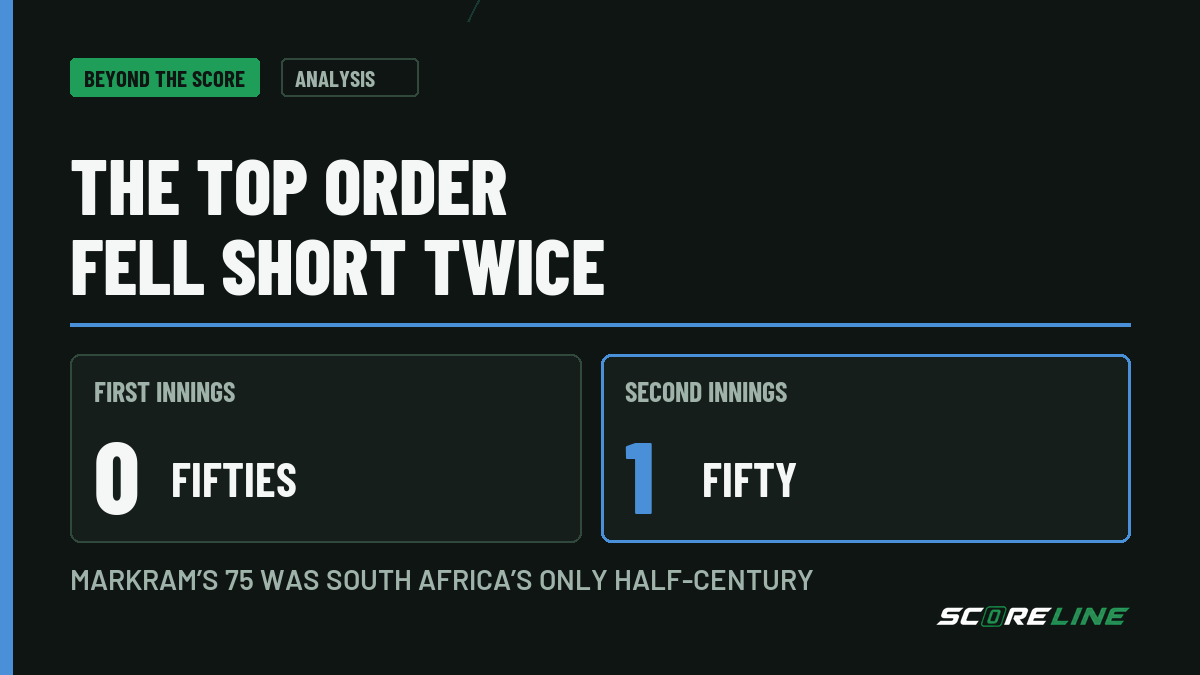
The Proteas top order problem is the story of this Test, more than Matt Renshaw’s runs or Josh Hazlewood’s final-day spell. Across two innings, South Africa’s specialist batters produced one score above 50. Australia were there to be beaten on the first afternoon, and the batting gave the advantage back. For the result and how the last day unfolded, read our first Test report. This piece is about the why.
The context: a world champion side on trust
South Africa arrived in Durban as the side that beat Australia by five wickets in the 2025 World Test Championship final at Lord’s. That win bought this group a great deal of credit, and coach Shukri Conrad has spent it carefully.
TimesLIVE’s Stuart Hess reported on Monday that Conrad has kept faith with the players who won at Lord’s, out of loyalty to a side that has delivered, at least to begin with and with a long summer ahead. It is a defensible position. Settled teams win Test series, and Temba Bavuma’s side had not lost a Test under him until Tuesday. Gulf News and CricketAddictor both record his captaincy before this match as 11 wins and a draw.
But loyalty is a loan, not a gift. At some point the runs have to come back.
The key moment: Australia were six down, and then they were not
Every Test has a hinge, and this one swung on the first two days, long before anyone was talking about 421.
Australia were 124/6 on Friday afternoon, according to TimesLIVE. South Africa had the chance to bowl them out for well under 250 and take a first-innings lead. Instead, Renshaw batted for 468 minutes. His ninth-wicket partnership with Nathan Lyon was worth 134, which TimesLIVE reported as a new record for Australia against South Africa, beating a mark of 78. Australia reached 390.
That is the moment the match turned. Not because the bowlers failed, they had done most of the job, but because of what it demanded from the batting next. When you have a Test side at 124/6, you have to make them pay for it. South Africa needed a big first-innings total, and the top order did not deliver one.
Proteas top order problem: what the numbers say
Start with the first innings, the one that decided the match. South Africa made 284 in reply to 390, and The Citizen noted that nobody reached fifty. David Bedingham top-scored with 49 from 73 balls. Markram’s 37 was next, then Simon Harmer, an unbeaten 35 from 75 balls over close to two hours, with Keshav Maharaj’s 34 just behind. When your two spinners score almost as heavily as your specialist batters, the deficit of 106 is not the tail’s fault.
The second innings told the same story with a single exception. Markram’s 75 from 237 balls, almost six hours of defence, was the only half-century South Africa made in the match. Bedingham came close again with 46. Around them, the numbers are stark.
| Batter | First innings | Second innings |
|---|---|---|
| David Bedingham | 49 | 46 |
| Tristan Stubbs | 32 | 1 |
| Kyle Verreynne | 13 | 1 |
| Aiden Markram | 37 | 75 |
| Wiaan Mulder | 30 | 29 |
| Temba Bavuma | 3 | 1 |
The trend runs back further than Durban. Hess points out that Ryan Rickelton has passed fifty once in his last 12 Test innings, and that his double hundred at Newlands came nearly two years ago. He went for 2 in the second innings here. Stubbs, who has batted at No 3 and in the middle order under Conrad, has five scores of 50 or more in 26 Test innings, by the same count.
Our view: none of these players has suddenly become a poor cricketer. The issue is that the top six, together, are not turning starts into the scores that set up a Test. When Australia’s ninth-wicket pair can add 134, a home top order has to answer with far more than 284.
Why Australia’s approach worked
Australia did not need anything clever. They bowled with discipline, used the short ball, and waited for mistakes. Our day-three report described how several first-innings wickets came from attacking shots, on a pitch where Australia had just made 390.
Then, with a lead, they batted with intent. Renshaw’s 82 on Monday came from 99 balls, and the declaration left South Africa with a target no side has ever chased in Test cricket. Our day-four report has the detail of that declaration. Hazlewood and the new ball did the rest on Tuesday afternoon, finishing with 6/49, a personal best in Tests.
There is a lesson in the contrast. Australia’s batters, including the ones who failed early, left the Proteas with a target. South Africa’s batters, including the ones who got in, left their bowlers without one.
The historical meaning of Kingsmead
Kingsmead has not been a happy Test ground for South Africa against Australia. Before this match, Australia had won their last three Tests here, going back to 2006, and South Africa’s last Test win over them at this ground came in 2002, a chase of 340/5. This defeat extends the wait.
It also ends something rarer. Bavuma’s unbeaten run as Test captain was one of the great stories of South African cricket since Lord’s. Losing it at home, to the side beaten in that final, stings. It also takes away the sense that this team cannot lose, which was never a fair expectation, but which every winning side enjoys while it lasts.
For context on the bigger picture, Wisden’s updated World Test Championship table now has South Africa third on 60.00 percent, behind Australia on 81.82 and New Zealand on 72.22. With only five Tests played in this cycle, every result moves South Africa’s percentage sharply, in either direction. Our ScoreLine Explains on World Test Championship qualification works through the scenarios.
What happens next for the Proteas
The second Test starts on Sunday 18 October at St George’s Park in Gqeberha, and the third at Newlands from Tuesday 27 October. TimesLIVE has already called Gqeberha a must-win match, and nobody in the dressing room will disagree: a second defeat would decide the series with a Test to spare.
The selection question is now open in a way it was not a week ago. Hess has suggested it may be time to give Marques Ackerman a chance, the uncapped Dolphins captain who was in the conversation for No 3 before the series, according to our preview. Conrad has said loyalty would come first, at least at the start. Kingsmead has tested that position. Whether it changes is the decision of the week. The squad and the selection calls so far are on our Proteas Test team page.
Our view: one bad Test does not end a winning era. But the pattern here is longer than one Test. If the top order fails again in Gqeberha, loyalty will no longer be the reason to keep the same names. It will be the excuse.
Frequently asked questions
Why did the Proteas lose the first Test against Australia?
South Africa’s batting was the main reason. They made 284 in reply to Australia’s 390, with no batter reaching fifty, and Aiden Markram’s 75 was their only half-century in the match. Australia recovered from 124/6 on the first day to post a big total, and their bowlers finished the job on day five.
What was the margin of the Kingsmead Test?
Australia won the first Test by 214 runs on the fifth day, Tuesday 13 October 2026. Josh Hazlewood took 6/49 in South Africa’s second innings, and Australia go to Gqeberha 1-0 up with two Tests left.
Who was the player of the match at Kingsmead?
Matt Renshaw was named player of the match. His scores of 190 and 82 carried Australia’s batting, and his part-time off-spin also brought him two wickets, his first in Test cricket.
Where does the defeat leave South Africa in the World Test Championship?
South Africa sit third in Wisden’s updated table with 60.00 percent. New Zealand are second on 72.22, and Australia lead on 81.82. South Africa have played five Tests in the 2025-27 cycle, so the next two results against Australia will move their percentage significantly.
When and where is the second Test between South Africa and Australia?
The second Test starts on Sunday 18 October 2026 at St George’s Park in Gqeberha. The third and final Test is at Newlands in Cape Town from Tuesday 27 October.