


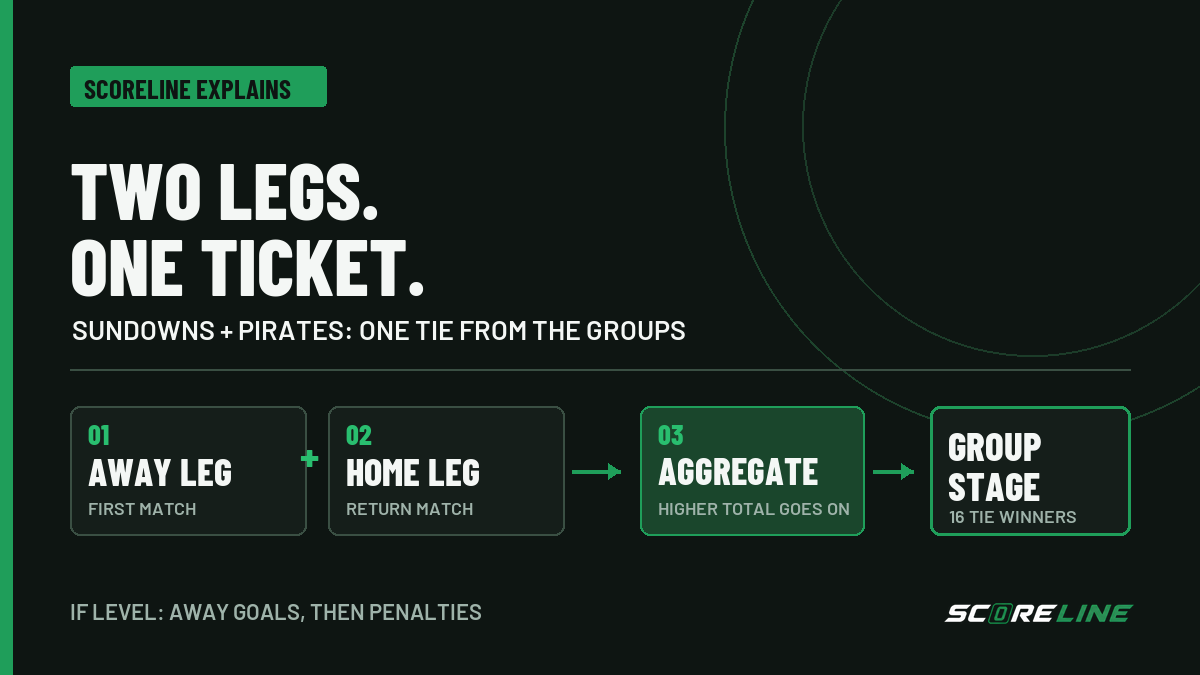
Being the best in Africa buys Mamelodi Sundowns a lot of things. It does not buy them a place in the group stage. Here is the short answer. The CAF Champions League explained in one breath: two preliminary rounds of two-legged ties, home and away, where the club with more goals across both games goes through; if the aggregate is level, away goals decide it, and if that is level too, it goes straight to penalties. The 16 clubs left standing after the second preliminary round, which starts this weekend, make up four groups of four from late November. Sundowns and Orlando Pirates are both one tie away.
| Quick facts | |
|---|---|
| Competition | TotalEnergies CAF Champions League 2026/27 |
| Clubs entered | 61 |
| Second preliminary round | First legs 16 to 18 October, return legs 23 to 25 October 2026 |
| South African ties | Wiliete (Angola) v Mamelodi Sundowns; African Stars (Namibia) v Orlando Pirates |
| Tie-break | Aggregate score, then away goals, then penalties (no extra time) |
| Group stage | 16 clubs, four groups of four, six matchdays from 27 November 2026 to 24 January 2027 |
| Final | Window of 9 to 31 May 2027 |
| Prize | USD 6 million to the winner |
CAF has published the windows for the second round, not yet one confirmed date, kick-off and venue for each South African tie, and reports differ. We will add them here once CAF or the clubs confirm.
The CAF Champions League explained, step by step
Step one: the draw splits the field by ranking. CAF entered 61 clubs this season. The three highest-ranked clubs in Africa, judged on their results in CAF competitions, were excused the first preliminary round: Mamelodi Sundowns, Espérance of Tunisia and RS Berkane of Morocco. The other 58 played 29 ties in September. Pots were drawn by geography to cut travel, and two clubs from the same country cannot be drawn against each other at this stage, so Sundowns and Pirates could never meet before the groups.
Step two: two games, one score. Each tie is a home game and an away game. Add the goals together and the higher total goes through. That is the aggregate.
Step three: when the aggregate is level. CAF’s regulations send the tie to away goals next: the club that scored more goals on the road goes through. If away goals are also level, or both games finish 0-0, there is no extra time. It goes directly to a penalty shoot-out. Extra time is kept for the final, which is a single match.
Step four: who hosts which leg. In the first preliminary round, a non-ranked club drawn against a ranked one hosted the first leg. In the second round, the club drawn first hosts the first leg, and the three seeded clubs, Sundowns among them, host the return legs. In practice, both South African sides open away and finish at home.
Step five: the groups. The 16 winners of the second round form four groups of four. Each club plays six matches, home and away against its three group rivals, between late November and late January. The group winners and runners-up go into the quarter-finals in February and March, then the semi-finals in April and a final in May.
How Sundowns and Pirates got here
The two South African clubs arrived by different doors.
Pirates are here as league champions. Their 2025/26 Betway Premiership title, won by a single point from Sundowns in May, was their first since 2011/12 and ended the Brazilians’ eight-season reign. That earned them South Africa’s champions’ place in this competition.
Sundowns are here as the holders. In May they beat AS FAR of Morocco 2-1 on aggregate to win their second CAF Champions League title, Ronwen Williams saving a penalty in the second leg in Rabat. CAF’s regulations say the holder must defend its title in the next edition. No country may send more than two, so South Africa’s places go to the league champions and the champions of Africa.
The worked example: Pirates. The Buccaneers were drawn among CAF’s ranked clubs and started in the first preliminary round against La Cure Waves of Mauritius, Champions League debutants. They drew 0-0 in Port Louis, then won 3-1 at Orlando Stadium for a 3-1 aggregate. Their opponents now, African Stars, are the Namibian champions, and they show exactly how fine the margins are: they lost their first leg to AS Mangasport of Gabon 3-1, won the return 2-0, and went through on away goals at 3-3. That one goal scored away from home was the whole tie.
The worked example: Sundowns. As seeds, the Brazilians waited in the second round for the winner of Wiliete of Angola against Foresters of the Seychelles. Wiliete won that tie 5-0 on aggregate. Sundowns play the first leg away to Wiliete and the return at home, the advantage CAF gives its three top seeds.
Why a Namibian club can host Pirates outside Namibia
Every Champions League match has to be played in a stadium homologated or authorised by CAF. Namibia currently has no stadium approved for the competition, according to reports from AfricaSoccer and Afrik-Foot. So African Stars are a home team without a home ground, and they must stage their home leg in another country. For their previous home match in this competition they used Lucas Moripe Stadium in Tshwane.
That is why the “home” leg against Pirates will not be in Windhoek. Where exactly it will be is the detail CAF and the clubs still need to confirm, so this page will be updated when they do.
Common misunderstandings
“Sundowns are the champions, so they go straight into the groups.” No. The holders skip only the first preliminary round. They still have to win a two-legged tie in October like everyone else.
“Away goals were scrapped.” Not in this competition. CAF’s regulations still use them, and four first-round ties this season were settled on away goals, African Stars’ among them.
“A level tie goes to extra time.” Not in the preliminary rounds, the quarter-finals or the semi-finals. A tie level on aggregate and away goals goes straight to penalties.
“Two South African clubs could meet in this round.” They cannot. The draw keeps clubs from the same country apart in the preliminary rounds.
“Win this week and you are straight into the groups.” Not quite. Win the tie across both legs, by 25 October, and you are in the group-stage draw. The first group matches are not until 27 to 29 November, more than a month after the second round ends.
Why it matters this season
For South African fans, this October is busy and strange. Sundowns and Pirates have just met in the MTN8 final, and they are separated by a point at the top of the league, Pirates with a game in hand, after winning on Tuesday night: Sundowns at Richards Bay and Pirates against TS Galaxy. Now both have to switch from the domestic grind to a knockout tie that starts away from home, with league fixtures waiting on either side.
For Mamelodi Sundowns, the job is to defend a crown without slipping on the first step. For Orlando Pirates, the league champions, the club will expect at least the group stage. Two legs, one ticket each. Away goals count. Nobody plays extra time.
Frequently asked questions
How does the CAF Champions League preliminary round work?
Each tie is played over two legs, one at home and one away, and the club with the higher aggregate score goes through. There are two preliminary rounds, and the 16 winners of the second round reach the group stage. This season’s second round has first legs on 16 to 18 October and return legs on 23 to 25 October 2026.
Does the CAF Champions League still use the away goals rule?
Yes. CAF’s regulations say that if the aggregate score is level, the club with more away goals goes through. Four ties in this season’s first preliminary round were decided that way. If away goals are also level, the tie goes to penalties.
Is there extra time in CAF Champions League two-legged ties?
No. In two-legged ties a level aggregate goes to away goals and then straight to a penalty shoot-out. Extra time is used only in the final, which is a single match.
Why are Sundowns and Pirates both in the CAF Champions League?
Pirates qualified as 2025/26 Betway Premiership champions. Sundowns qualified as the holders, having won the competition in May, and they also finished second in the league. No association may enter more than two clubs.
How many teams reach the CAF Champions League group stage?
Sixteen. They are split into four groups of four and play six matches each from late November to late January. The group winners and runners-up reach the quarter-finals.